
Women-Led Development in India: From Welfare to Economic Empowerment
From Beneficiaries to Builders
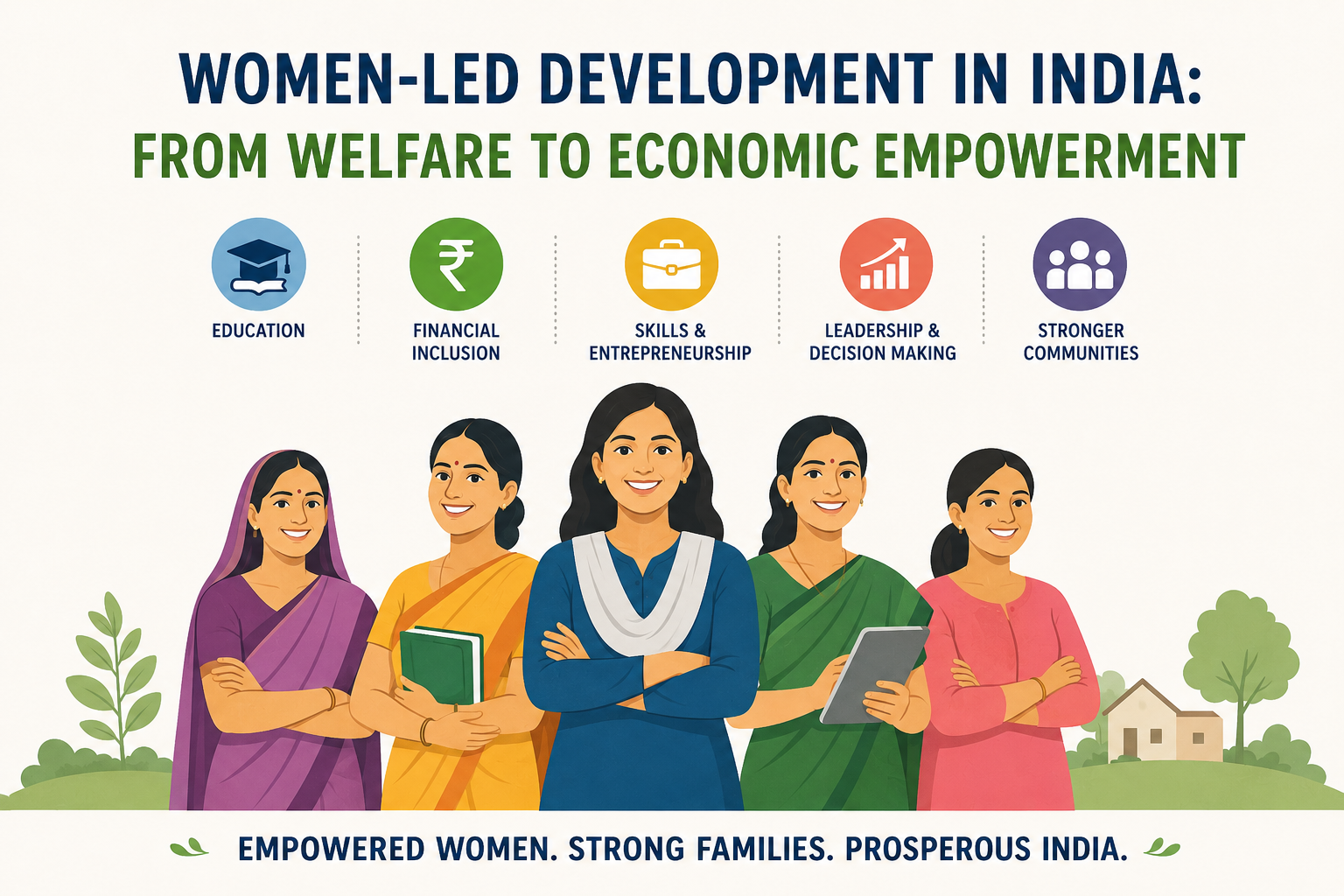
For most of independent India's history, government policy treated women as people who needed to be looked after. Schemes were built around protection, nutrition, safety, and basic literacy. That approach was necessary, and it did real good, but it also carried a quiet assumption: that women were beneficiaries of development, not drivers of it. Over the last decade, that assumption has started to crack. India is now talking about "women-led development" rather than just "women's development," and the difference is not just semantics. It marks a shift from women as recipients of welfare to women as agents who build businesses, manage credit, sit in panchayats, and shape their own economic futures.
The Self-Help Group Story
The scale of this shift is easier to see through numbers. As of mid-2026, close to 10 crore women across India are organised into roughly 90 lakh Self-Help Groups, mobilised largely through the Deendayal Antyodaya Yojana–National Rural Livelihood Mission. These groups began decades ago as small, informal circles where a handful of women pooled savings so they could lend to each other, mostly to escape the grip of local moneylenders. Today they function as something closer to grassroots financial institutions, linking rural women to bank credit, teaching basic financial literacy, and increasingly pushing members from simply borrowing money into actually running enterprises. Programmes like SHE-MARTs and the "Lakhpati Didi" initiative are explicit about this next step: they want SHG members to become shop owners and small manufacturers, not just loan recipients.
Why the Economics Matter
This matters because the economic case for including women is not a side issue in India's growth story, it may be central to it. Despite making up close to half the population, Indian women contribute a strikingly small share of measured GDP, and various estimates suggest that closing the gender gap in employment could meaningfully boost the country's overall output. That gap shows up starkly in everyday life, in the form of unpaid domestic and care work. Recent time-use data shows women spending roughly five hours a day on unpaid domestic duties, compared to a fraction of that for men, with caregiving responsibilities falling disproportionately on women as well. This invisible workload is one of the biggest reasons women drop out of the labour force, reduce their working hours, or end up in informal jobs that offer no security and few benefits. Any serious attempt at economic empowerment has to reckon with this imbalance, not just with access to credit or skills.
Safety as a Precondition for Empowerment
The government's own architecture for women's development has evolved to reflect this broader thinking. Mission Shakti, the umbrella scheme running through the current Finance Commission period, tries to bring together safety and empowerment under one roof, on the theory that a woman cannot build an economic life if she does not first feel secure. Its safety arm includes One Stop Centres, the women's helpline, and community-based justice forums, while its empowerment arm rolls together older programmes on maternity benefit, working women's hostels, and childcare support, alongside newer efforts aimed squarely at enterprise ownership. The logic is straightforward: physical safety, childcare support, and economic opportunity are not separate problems that can be solved in isolation.
Leadership at the Grassroots
Political representation is the other pillar of this story, and it long predates the current push on livelihoods. The 73rd Constitutional Amendment, passed in 1993, reserved a third of seats in local panchayats for women, and many states have since raised that reservation to fifty percent. This has put more than a million women into positions of local political authority, a scale of representation that is unusual globally. Research on grassroots women leaders in India points to a few recurring patterns: some become effective economic mobilisers who bring investment and credit into their villages, others act as social advocates who push back against harmful norms, and a smaller group becomes skilled institutional navigators who know how to work the levers of local government. Studies of SHG-linked leadership have found real gains from this kind of participation, including notable increases in household income and in women's presence in panchayat decision-making, though researchers are also candid about the limits: elite capture within groups, uneven digital access, and the risk that formal representation does not always translate into real decision-making power.
The Road Still Ahead
None of this means the transition from welfare to empowerment is complete, or even close to it. India's ranking on global gender gap indices remains poor, and female labour force participation, while it has ticked upward in recent years, is still well below where it would need to be to fully capture the economic upside experts point to. Digital access, land and property rights, and the sheer weight of unpaid care work remain real obstacles. But the direction of policy has genuinely changed. The conversation has moved from asking how to protect women to asking how to back them, whether that means routing more credit through SHGs, expanding enterprise schemes like SHE-MARTs, or simply making sure a woman elected to a panchayat is treated as its leader rather than a placeholder for a male relative. Welfare gave women a floor to stand on. Economic empowerment is now about giving them room to build.
References
1. Countercurrents. (2026). Half the Population, Full Potential: Women-Led Development as India's Growth Strategy.
2. Vision IAS. (2025). Women-Led Development. Current Affairs Monthly Magazine.
3. Socio.Health. (2026). Top Government Schemes for Women's Development in India.