
The Hidden Cost of Green Power: How Solar and Wind Are Displacing Farmers and Herders in Kutch and Rajasthan
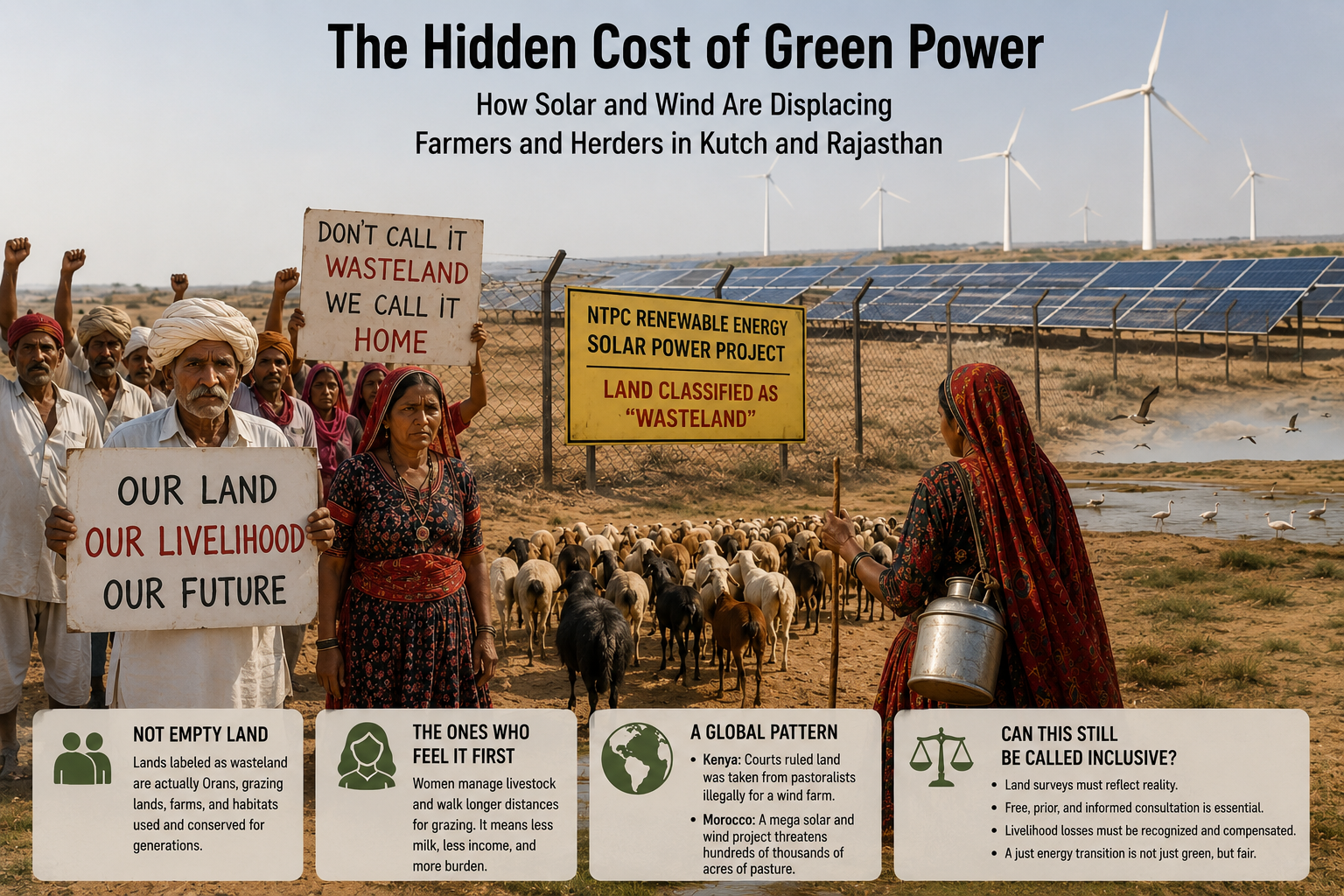
It was 45 degrees Celsius outside on May 22, the kind of heat that keeps most people indoors, but that day more than 500 people walked out into the desert near Fulay village anyway. Most of them were Maldhari herders, joined by residents from sixteen villages across Kutch's Banni grasslands. It happened to be the International Day for Biological Diversity, and nobody there missed the irony. They had come to stop a solar project (Shah, 2026).
That one protest tells you a lot about where India's clean energy push is actually headed, and who's being asked to foot the bill for it.
It Was Never About Solar Power
The problem wasn't solar power itself. It was the plot NTPC Renewable Energy had picked for it, land sitting inside the Chhari-Dhand wetland reserve, a stretch of marsh that had just earned Ramsar protection for the migratory birds that stop there every year (Shah, 2026). By the time India Today spoke to villagers, they were already describing bulldozers on site, months before anyone had actually sorted out who the land belonged to. And this wasn't scrubland by any stretch. People pointed to old settlements sitting on it, farm plots their families had worked for years, shared grazing patches, even graves (Shah, 2026).
That Word "Wasteland" Is Carrying A Lot
That's the trouble with the word "wasteland." Government records use it freely, but on the ground it rarely means what it sounds like. Head over to Rajasthan's Thar Desert and you'll find whole tracts of so-called wasteland are actually Orans, patches of common grazing land that Rabari herders and others have quietly protected for generations, long before anyone drew a district boundary through them. Nobody holds a title to an Oran. Everyone just uses it, and in exchange, everyone looks after it. That system is now under real strain. Solar and wind projects keep pushing further into Jaisalmer's Orans, and herders are running out of places to actually graze their animals (Ghosh, 2026).
The Ones Who Feel It First
Ask around and one thing keeps coming up: it's the women who absorb most of this loss. In herding households, managing the livestock day to day usually falls to them. So when a nearby pasture gets fenced off or paved over for panels, they're the ones who have to walk animals further out to find grass that's still left, sometimes for hours longer than before. Thinner, more exhausted animals also mean less milk and less money coming into the household (Ghosh, 2026).
And this isn't just happening in India. Look at Lake Turkana in Kenya, home to Africa's largest wind farm, where courts eventually found that land had been taken from local pastoralists illegally. Or look at Morocco, where a $20 billion plan to send solar and wind power to Britain through an undersea cable could end up eating into more than 300,000 acres of pasture that nomadic herders still rely on (Yale E360, n.d.). Different countries, different governments, but somehow the same story keeps repeating itself: land that looks empty on paper turns out to be full of people the moment you actually visit it.
Can This Still Be Called Inclusive?
None of this means solar or wind power is the villain here. India needs the electricity, and next to coal or gas, renewables genuinely take up less land and do far less damage over time. Nobody's really arguing against that.
What's worth arguing about is how the land gets chosen and who actually gets consulted before construction starts. Right now the pattern is fairly predictable: pick land tagged as marginal, move quickly, and deal with the objections after the machines have already rolled in. The protest at Fulay is a pretty clear example of what happens when that approach runs into people who simply won't stay quiet about it.
If India actually wants its energy transition to be a just one, not just a green one on paper, it has to stop treating these deserts like empty space waiting to be filled. Kutch and the Thar are anything but empty. They're home to farmers, herders, birds, and entire ways of life that existed long before anyone thought to plant a turbine there. Until land surveys, consultations, and compensation start reflecting that reality, protests like the one at Fulay aren't likely to stop anytime soon.
References
Ghosh, S. (2026, July 17). How renewable energy projects in Jaisalmer impact women, livestock & livelihoods. Feminism in India.
Shah, J. (2026, May 26). Wetland greens or energy clean? Why Kutch pastoralists are in protest. India Today.
Yale E360. (n.d.). 'Green grab': Solar and wind boom sparks conflicts on land use. Yale School of the Environment.