

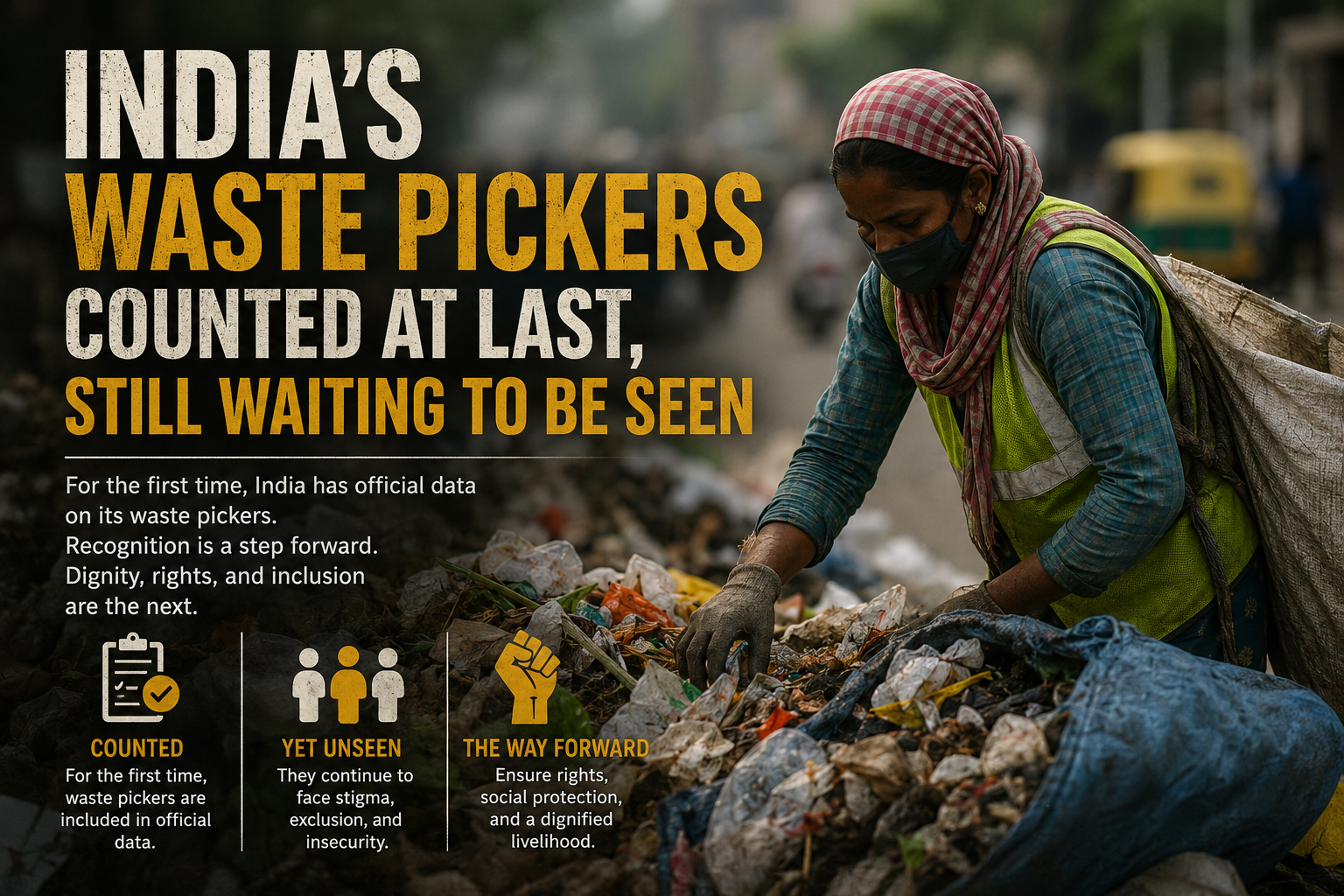
India's Waste Pickers: Counted at Last, Still Waiting to Be Seen
For decades, the people who keep India's cities from drowning in their own garbage have existed in a strange kind of limbo, essential to how urban waste actually gets managed, yet almost entirely absent from the paperwork that governs it. That changed, at least on paper, in early 2026, when the Union government released the first-ever nationwide enumeration of waste pickers under its NAMASTE scheme.
The headline number is striking on its own: 52 lakh waste pickers counted across 35 states and union territories (Insights on India, 2026). But the data behind that number tells a sharper story. Of those enumerated, 84.5% belong to Scheduled Caste, Scheduled Tribe, or Other Backward Class communities figure that confirms what anyone who has spent time around India's informal waste economy already suspected: this is not just precarious work, it is work stratified sharply along caste lines, with the most hazardous and least protected jobs falling disproportionately to the most marginalised communities (Insights on India, 2026).
What Counting Actually Changes
There's a reason enumeration matters more than it might sound like it should. Waste pickers have historically fallen outside the reach of labour protections not because policymakers decided to exclude them, but because they were never formally recorded as workers in the first place no registry, no identity card, no official category to slot them into. NAMASTE, which stands for National Action for Mechanised Sanitation Ecosystem, was originally built around sanitation and sewer workers before its scope was expanded to include waste pickers, and that expansion is being described as a genuine shift in how the government treats this workforce not merely as informal labour to be tolerated, but as employees whose work is essential to how urban waste systems actually function (CAG, 2026).
Waste pickers, the same analysis notes, often achieve higher rates of segregation and material recovery than the formal systems municipalities have spent years building a claim that inverts the usual assumption that informality is a problem to be engineered away rather than a system already working, just invisibly (CAG, 2026). Under the scheme, beneficiaries are meant to receive occupational identity cards, which sounds bureaucratic until you consider what it unlocks: access to health insurance through Ayushman Bharat, safety gear, and skill training that this workforce has functioned without for generations (CAG, 2026).
The Gap Between Recognition and Reality
Here's where the story gets less tidy. India generates somewhere between 1.4 and 3.2 million tonnes of e-waste every year, depending on which estimate you use, and by most accounts is the world's third-largest producer of it (Mongabay India, 2026). Buried inside that waste stream is an estimated $4.9 billion worth of recoverable critical minerals and metals value that is, right now, mostly lost to unsafe and inefficient informal dismantling, precisely because the people doing that dismantling have no substantial legal recognition under the country's formal e-waste rules (Mongabay India, 2026). Shambhu Yadav's story, reported from Pune, captures what this looks like at ground level: he travelled from Meerut in Uttar Pradesh in search of work, arrived with no formal training, and ended up doing what millions of others in his position do collecting scrap for a kabadiwala, sorting it by hand, and selling it up a chain of dealers who capture most of its eventual value (Mongabay India, 2026).
Some NGOs are trying to close that gap. In Pune, a collaboration through the SwaCH cooperative has given waste pickers formal affiliate status within the city's waste management system, letting them sell dry solid waste directly to recyclers for extra income (Mongabay India, 2026). But as the reporting on this makes clear, these efforts remain "few and far between" nationally pockets of good practice surrounded by a much larger system that still hasn't caught up (Mongabay India, 2026).
New Rules, Old Fault Lines
The policy architecture around all of this shifted again with the notification of the Solid Waste Management Rules, 2026, in January the first major overhaul since 2016. The new rules continue to reference informal waste collectors and acknowledge their role within the waste ecosystem, much as the 2016 rules did. But acknowledgment on paper has never been the hard part.
What This Actually Adds Up To
Taken together, these three threads the NAMASTE enumeration, the NGO-led integration pilots, and the new SWM rules describe a system in transition rather than a system that has arrived anywhere final. India now has, for the first time, a rough headcount of who these workers are and which communities they come from. It has scattered, small-scale models showing that formal integration is possible without destroying the flexibility that makes informal waste recovery so efficient in the first place. And it has a new regulatory framework that mentions waste pickers by name but still leaves the mechanics of inclusion largely to municipal bodies that have historically struggled to implement even simpler provisions.
None of this guarantees that the 52 lakh people counted this year will see meaningfully different working conditions next year. Being counted is not the same as being protected, and being named in a rulebook is not the same as being paid fairly for work that keeps a city functioning. But it is, at minimum, a starting point that didn't exist before a record that these workers exist, do essential work, and are owed something more than the informal, invisible arrangement they've been left to navigate on their own for decades.
References
CAG. (2026). A step towards recognition: What the NAMASTE scheme means for waste pickers. Citizen consumer and civic Action Group.
Insights on India. (2026, February 4). NAMASTE scheme: Waste-pickers enumeration and social justice. https://www.insightsonindia.com/2026/02/04/waste-pickers-enumeration-under-namaste-scheme/
Mongabay India. (2026, May 22). How NGOs are bringing India's informal waste collectors into the system. https://india.mongabay.com/2026/05/how-ngos-are-bringing-indias-informal-waste-collectors-into-the-system/