

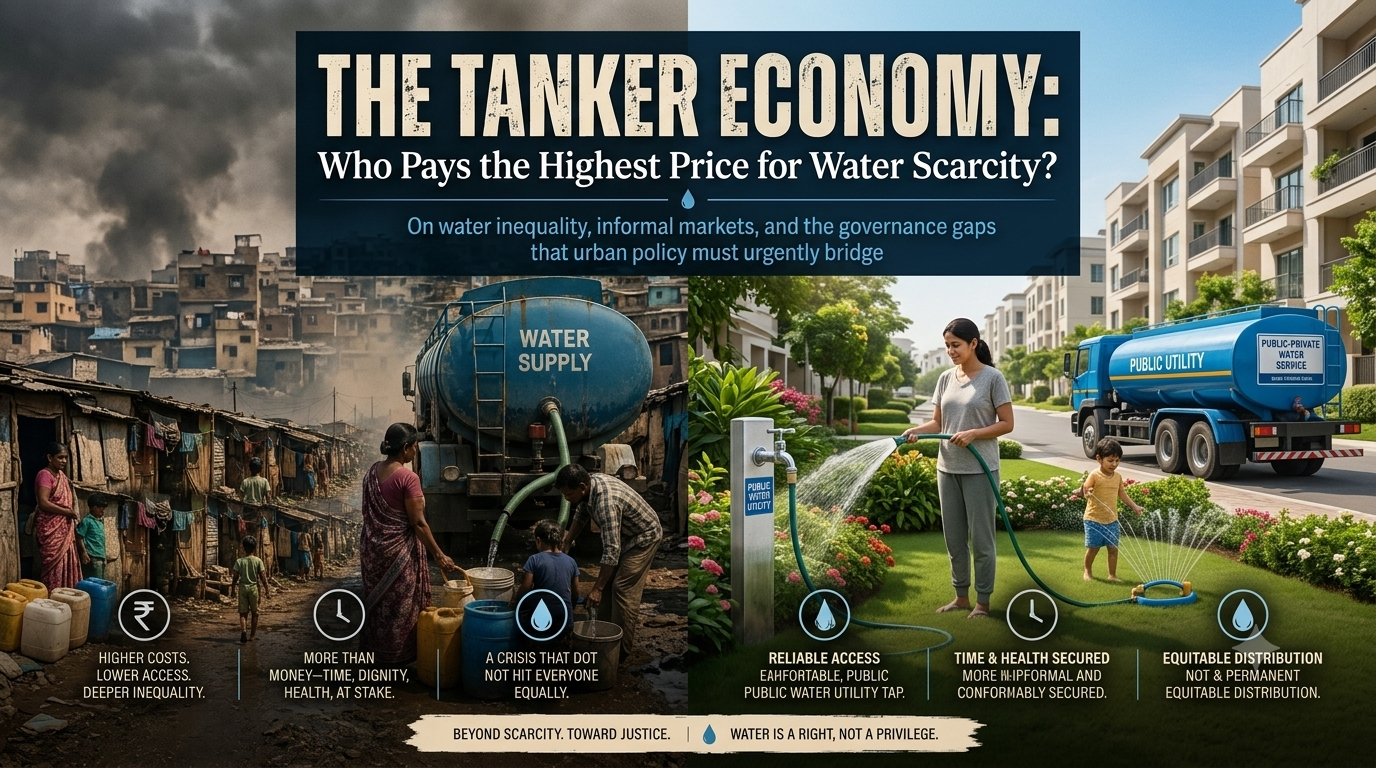
The Tanker Economy: Who Pays the Highest Price for Water Scarcity?
On water inequality, informal markets, and the governance gaps that urban policy must urgently bridge
There is a particular cruelty embedded in the economics of water scarcity. The less water you have access to, the more you pay for it — not just in money, but in time, dignity, and health. Across India's cities, this paradox has quietly solidified into an entire shadow economy: one built on tanker trucks, private vendors, bootlegged pipes, and the daily gamble of the urban poor.
This is the tanker economy. And understanding who bears its costs — and why — offers a window into one of urban India's most pressing and complex infrastructure challenges.
The Supply-Demand Gap
On paper, India should not have a water crisis this severe. The country receives roughly 4,000 billion cubic metres of precipitation annually. It contains 4% of the planet's freshwater resources. But possession, as any urban water researcher will tell you, is not the same as access.
Delhi's daily water demand stands at roughly 1,290 million gallons. The formal supply is approximately 1,000 million gallons — a structural shortfall of nearly 300 million gallons that has persisted for decades. Chennai faces a supply-demand gap of over 200 MLD (million litres per day), with close to 6,530 deep borewells dug across the city to supplement an overstretched distribution network.
And yet, wealthy households in both cities turn on their taps every morning with little anxiety. The crisis does not hit everyone equally. What fills the gap between formal supply and actual demand is a market which is highly informal, unregulated, and expensive
The Price of Informality
The most damning statistic in urban water economics is also one of the simplest: in Mumbai, tanker water costs 52 times as much as piped water. In Bengaluru, it is 12 times as much.
These figures are drawn from a World Resources Institute working paper which exposes the real architecture of urban water access. Piped water in India is heavily subsidised. But that subsidy flows only to those already connected to the formal network. Residents of informal settlements, i.e the poorest urban households, are systematically excluded from this network. Even though they pay the premium price, they don’t receive the subsidy.
The World Bank recommends that a household spend no more than 3-5% of its monthly income on water. In India's informal settlements, where tanker dependency is the new normal, households can spend up to 15% of their income on water that arrives irregularly, in insufficient quantities, and of uncertain quality.
In Mumbai's informal settlements, individuals sometimes receive less than 20 litres per day which is below the minimum daily consumption level recommended by the WHO. Some citizens in these settlements end up paying 40 times more for water than their neighbours in formal housing a few streets away, often resorting to black market sources to make up the shortfall.
What looks like a market self-correction is a market failure dressed up as an equilibrium.
Anatomy of the Informal Water Market:
The tanker economy is not monolithic. It is a layered informal system with its own logic, pricing hierarchies, and power structures.
At its simplest, it involves private tanker truck operators who source water — often from groundwater wells or, ironically, from municipal supply points — and sell it to households, construction sites, and commercial establishments at rates set entirely by them. In the absence of regulation, prices fluctuate with season, demand, and proximity to the settlement.
But the system is more complex than a simple vendor-buyer transaction. Research from Mumbai's Mandala neighbourhood documents a heterogeneous ecosystem of water access: public community taps, borewell taps, shared tanks, private vendor hoses, tanker trucks, and well water — often used by the same household in overlapping configurations. Informal vendors frequently tap into public pipes to distribute water to nearby households, blurring the line between public infrastructure and private enterprise.
Legal status also determines access. In Mumbai, GIS mapping of water infrastructure found dramatic disparities between "notified" and "non-notified" slum neighbourhoods. Non-notified households were significantly more likely to depend on tanker trucks — one of the least secure and most expensive water sources — and were far less likely to have access to in-home taps or even informal hose vendors. The administrative act of recognition (or the lack of it) becomes a water access determinant.
In Chennai, the city government itself uses approximately 6,000 private tanker trucks with capacities between 10,000 and 20,000 litres to deliver water across areas with poor coverage — a pragmatic short-term response that also highlights the urgency of formalising quality and pricing standards for this parallel supply system.
The Gender and Time Tax
Water scarcity carries a gender dimension that rarely surfaces in economic analyses of the tanker market.
In households dependent on tankers or community taps, the labour of water procurement falls disproportionately on women and girls. Waiting for a tanker that may or may not arrive, carrying containers from distant sources, managing storage — these are unpaid, time-intensive activities that constrain women's participation in paid work, education, and civic life.
The "time cost" of water scarcity is a real economic cost, even if it appears in no market price. When a tanker rolls through a narrow lane every five days, the scramble it triggers — the rush, the rationing, the physical effort — is a form of labour performed by the most economically marginalised, without compensation, and without end.
Governance Challenge: Complexity, Not Absence
If the tanker economy were simply the result of genuine water scarcity, the policy prescription would be straightforward: build more infrastructure, invest in supply. But the challenge runs deeper than supply alone — it is rooted in the structural complexity of governing rapidly expanding, highly heterogeneous cities.
One of the persistent tensions urban administrations face is the relationship between service provision and land tenure. Extending piped water to informal settlements raises difficult questions about regularisation and land-use planning that go beyond the water sector itself. Navigating these questions while continuing to expand coverage is a genuine governance challenge — one that requires coordination across multiple departments, levels of government, and legal frameworks simultaneously.
India's Jal Jeevan Mission reflects the scale of ambition the government has brought to this problem — promising household taps for 191 million homes by 2024, a commitment that represents one of the world's largest water access programmes. Implementation has been uneven, with challenges around last-mile connectivity and ensuring that installed infrastructure is backed by reliable supply. India also ranks 122 out of 124 countries on the 2024 World Water Quality Index, underscoring that the sector's goal must extend beyond access to safe, potable water — a distinction that demands continued investment in treatment and quality monitoring.
Delhi's Heat Action Plan 2025 included an ambitious target of 3,000 water ATMs citywide, a forward-looking intervention aimed at easing the burden on informal settlements. Scaling such initiatives to the pace that urban need demands remains the central implementation challenge. Bridging the gap between policy intent and ground-level delivery — particularly for the most marginalised households — is where the next phase of urban water governance needs to focus.
The Groundwater Spiral
There is another dimension to the tanker economy that rarely features in discussions of water inequality: environmental externalities.
Private tanker operators, unsanctioned borewells, and industrial extraction are collectively driving groundwater depletion at a rate that exceeds both the United States and China combined. In Delhi, newer areas in the National Capital Region that are unable to access Delhi Jal Board supply have resorted to over-extraction of groundwater, which is in turn leading to contamination. A Central Ground Water Board report found uranium deposits exceeding safe limits in over 15% of groundwater samples collected from sites across Delhi. In Chennai, over-exploitation of groundwater by private water tanker operators in core urban areas has resulted in seawater intrusion, degrading the quality of water extracted for public supply.
The informal market does not just exploit scarcity. It manufactures future scarcity. Those who will pay the price for depleted aquifers and contaminated wells will, once again, be those with the least capacity to cope.
What an Equitable Water Economy Might Look Like
The tanker economy is often treated as a stopgap — an unfortunate but temporary feature of a developing urban landscape. It is neither temporary nor accidental.
Addressing it requires a reorientation of urban water governance around three principles that are rarely held simultaneously:
Recognise informality rather than penalise it.
Extending formal infrastructure to informal settlements is not the same as legitimising disputed land claims. The conflation of service provision with tenure formalisation has been used too long as a reason to withhold basic resources from urban poor communities. Service access can and should be decoupled from administrative settlement status.
Restructure the subsidy architecture.
The current system subsidises piped water — a benefit that flows to those already connected, which disproportionately means middle-class and higher-income households. Targeted subsidies or voucher mechanisms that allow informal-settlement households to access water at regulated prices would begin to reverse this inversion.
Regulate, don't ignore, the informal market.
Private tanker operators are not going away. Establishing price regulation, water sourcing standards, and quality norms for the informal water market — acknowledging it as a structural feature of Indian urban water supply, not a temporary anomaly — would reduce the predatory pricing that characterises it today.
The path forward requires all three shifts working together — and the good news is that each has precedent in Indian cities already experimenting with more inclusive water governance models.
Water inequality in urban India is not a problem of insufficient data. The numbers exist: the 52x price differential in Mumbai, the 15 per cent income share spent on water by informal settlement residents, the 200 MLD supply gap in Chennai. These figures point clearly to where investment, regulatory attention, and implementation energy need to be directed.
Translating data into accelerated, last-mile action — particularly for urban communities that remain outside formal supply networks — is the defining challenge for urban water governance in the decade ahead. India's demographic trajectory and climate exposure make this not a future problem but an immediate one.
The question of who pays the highest price for water scarcity is, ultimately, not just a technical one. It is a question about equity, inclusion, and ensuring that India's urban growth story reaches every household — including those in its most informal corners.