
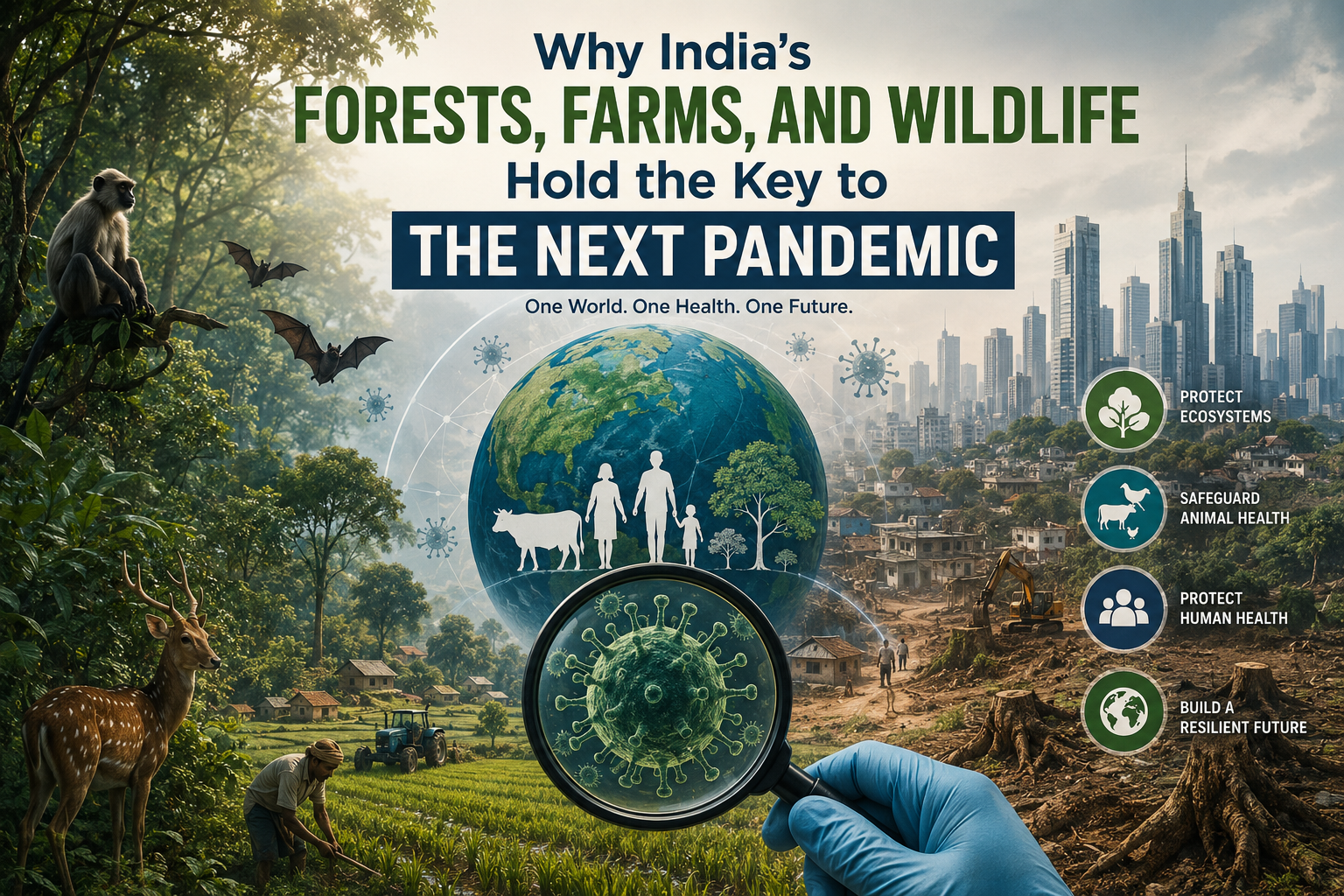
Why India's Forests, Farms, and Wildlife Hold the Key to the Next Pandemic"
Introduction
The global COVID-19 pandemic of 2020 revealed a harsh reality: despite tremendous advancements in technology and medicine, humans remain susceptible to infectious diseases arising from the natural world. Millions of people died, health systems were overburdened, and economies were supended by the pandemic. However, COVID-19 was not an unexpected event for many scientists. It served as a caution.
A growing number of public health specialists now concur that the next pandemic might not originate from a remote outbreak or a lab. It might result from the increasing strain humans put onnatural ecosystems. Humans, animals, and the environment are interacting inpreviously unheard-of ways as forests decrease, wildlife habitats disappear, and climate patterns change. These interactions provide diseases the chance to transcend species boundaries and infiltrate human populations.
The question is no longer whether another zoonotic outbreak will occur. The question is whether we will be prepared when it does.
The Numbers We Cannot Ignore
The challenge posed by zoonotic diseases is frequently underestimated.
Global health estimates indicate that around 75% of newly developing infectious diseases have zoonotic origins, whereas about 60% of recognized infectious diseases impacting humans have animal origins. Animal-to-human transmission gave rise to diseases including COVID-19, SARS, Ebola, MERS, avian influenza, and Nipah virus.
The social and economic ramifications are equally concerning. Before COVID-19, zoonotic infections were thought to have cost the world economy $100 billion over the course of two decades. Neglected zoonotic infections cause about two million deaths per yearin low- and middle-income countries alone, disproportionately affecting vulnerable populations who rely largely on livestock and natural resources.
These numbers emphasize an important fact: zoonotic illnesses are not uncommon occurrences. They arerecurring public health threats that have become increasingly frequent in anera of environmental change.
The Human-Animal-Environment Interface: Where Spillover Begins
Natural ecosystems served asbarriers between humans and wildlife for the most of human history. These days, those buffers are vanishing.
Humans and wildlife are cominginto closer contact than ever before due to rapid urbanization, agricultural expansion, infrastructural development, mining operations, and deforestation. The human-animal-environment interface, as it is commonly known, has emerged as the focal point of new infectious disease threats.
Animals are compelled to migrate and adapt to environments controlled by humans when forests are cut or fragmented. Pathogens that are harmless to bats, rats, monkeys, and other animal species can be fatal to people. Opportunities for disease spillover grow as interactions do.
This dynamic is further complicated by farming. Systems for raising animals at high densities may serveas amplification sites, enabling viruses to change, proliferate, and possibly develop the capacity to infect people.
Climate Change: Accelerating the Risk
There is a growing recognition that climate change has a significant impact on the emergence of infectious diseases. The changing climate is altering the range of disease-carrying organisms such as mosquitoes and ticks due to increased temperatures, altered rainfall patterns, extreme weather events, and shifts in ecosystems.
Diseases that were once confined to specific regions are now beginning to spread to new locations. Climate change also affects the behaviours and migration routes of wildlife. As species move in search of food, water, and suitable habitats, they meet different animal populations and human communities, creating new opportunities for diseases to spread across various species and regions.
Additionally, challenges like heat stress, loss of biodiversity, flooding, and environmental deterioration diminish ecological resilience, heightening the chances for infectious diseases to arise and disseminate.
One Health: Rethinking How We Prevent Pandemics
The One Health approach has been adopted as a result of the increasing awareness of the interconnectedness of disease onset.
One Health acknowledges the interdependence of environmental, animal, and human health. In order to address health risks at their source rather than waiting for outbreaks to happen, it encourages cooperation between doctors, veterinarians, environmental scientists, ecologists, legislators, and communities.
The approach focuses on several key priorit
• Integrated surveillance systems across human and animal populations
• Strengthened veterinary services and animal health monitoring
• Biodiversity conservation and ecosystem protection
• Sustainable agricultural practices
• Responsible use of antimicrobials
• Community awareness and risk communication
By identifying threats early and addressing their underlying drivers, One Health offers a pathway from reactive crisis management to proactive prevention.
India's Opportunity and Responsibility
In the global conversation about zoonotic diseases, India occupies a distinctive position. With one of the largest cattle populations globally, remarkable biodiversity, and rapidly developing urban areas, the country is particularly susceptible to zoonotic risks.
Persistent focus is essential, as demonstrated by recent occurrences of Kyasanur Forest Disease, Nipah virus, avian influenza, and other zoonotic diseases. Concurrently, India has made significant strides in promoting collaboration across sectors, enhancing laboratory networks, and improving disease surveillance. Notable advancements have been achieved through programs like the Integrated Disease Surveillance Programme (IDSP) and ongoing efforts to institutionalize the One Health approach.
However, addressing future threats will require deeper integration between public health, veterinary science, environmental management, agriculture, and climate adaptation efforts.
Conclusion
The COVID-19 pandemic revealed that the expenses associated with responding to a pandemic far exceed the costs of preventing one. Nevertheless, the environmental and ecological factors that led to previous outbreaks continue to escalate.
If COVID-19 served as a global alarm, zoonotic diseases remind us that the fight against pandemics starts well before the initial patient arrives at a hospital. It initiates within our forests, farms, markets, and ecosystems. The next pandemic may already be forming at the crossroads of environmental changes, animal health, and human actions.
Acknowledging these interconnections and investing in prevention through the One Health approach could be our most effective strategy for defence. In our interconnected world, safeguarding human health fundamentally entails safeguarding the health of animals, ecosystems, and the planet we all inhabit.