

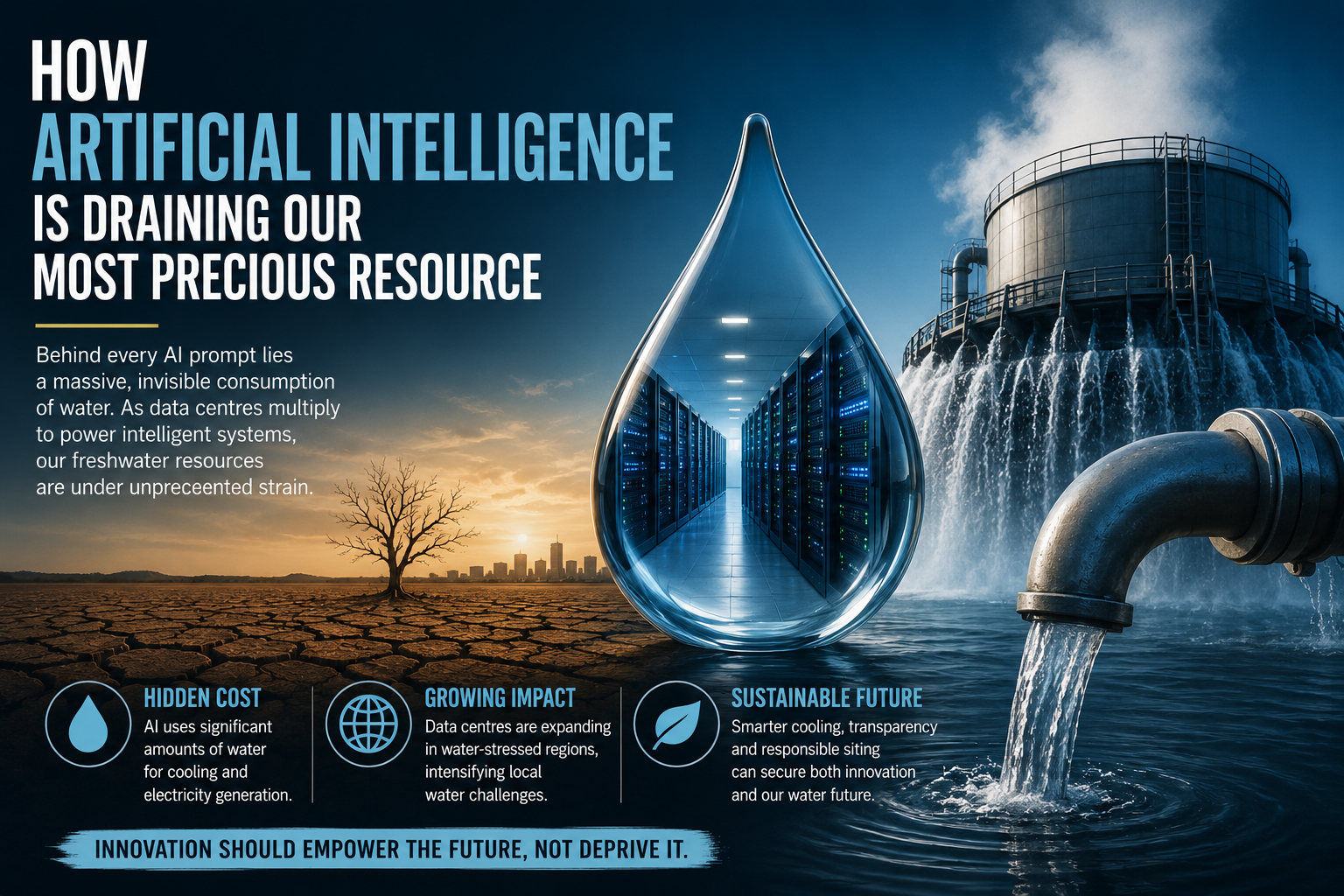
How Artificial Intelligence Is Draining Our Most Precious Resource
Whenever you type in a prompt into a Chatbot, there is something happening that is invisible to you. Inside a windowless building (probably in Virginia, but maybe in Arizona, or maybe in rural Georgia) banks of servers are under strain, generating heat that needs to be removed. More and more, it is the stuff that removes that heat from the system, water. Lots of it.
AI has been a big consumer of electricity for the past few years, and we've been worrying about it. However, a more subtle and more likely compelling narrative is playing out too, artificial intelligence is emerging as one of the fastest-growing threats to the world's freshwater supply just as droughts, aquifer depletion and water stress are becoming increasingly severe worldwide.
The hidden cost of a Chatbot Reply
There are two predominant approaches to cooling data centers. Some employ the evaporative cooling towers which absorb heat and evaporate it into the atmosphere, which are effective, but the water is lost from the system and becomes unavailable. Others prefer the alternative of using more electricity for air conditioning or closed-loop liquid cooling, instead of consuming water. In either case, there's a footprint. The "indirect" water used by the power plants that produce the electricity used by a data center's equipment also counts, since thermoelectric plants use a ton of water for cooling.
The University of California, Riverside has calculated the staggering amount of water, about 1/2 of a liter, or 1 bottle, per 100 words of AI prompt, taking into consideration the electricity and cooling required. For one question, that's no big deal. If you multiply it by the billions of prompts submitted each and every day, then it does not seem like a trivial thing anymore.
The Numbers Are Getting Hard to Ignore
A 2026 United Nations University report tried to give the whole picture, and here are the results - In one recent year, the electricity requirements for global data centers exceeded the electricity use of approximately 10 countries in the world; the electricity was generated using about 1.2 trillion gallons of water. If the projection of an AI energy consumption of 40% by 2030 is true, as many analysts predict, then the total water consumption from AI alone could reach 9.3 trillion litres annually, enough to provide the basic domestic water needs of more than a billion people in Sub-Saharan Africa.
It's the same story from the ground up that is being revealed by government and industry disclosures. The researchers estimate this to increase to 38 billion to 73 billion gallons per year in the United States in 2028, and the potential for further growth exists. In its own environmental reports, Google revealed that its data centers used 4.3 billion gallons of water in 2021, increasing to 6.1 billion gallons in 2024, with the company specifically stating that part of this rise is due to the growth of AI workloads. For the first time, Amazon has revealed a global total of 2.5 billion gallons of use in 2025.
Not All Communities Bear This Equally
What sets apart this crisis from something like agriculture's water usage is where this need for water is coming from. Data from Bloomberg Intelligence and World Resources Institute indicate that most new data centers for artificial intelligence in the United States have been constructed in areas which already have water scarcity problems, and there has been an increase of about 70 percent in this regard over the last three years.
The human examples are striking. A Meta data center in Newton County, Georgia, uses 500,000 gallons of water per day, around 10 percent of the county’s total water usage and further plans are currently in motion that would see individual centers use up to 6 million gallons per day, thereby exceeding the total water usage of the county. The data center in Uruguay sparked controversy during the drought of 2023 that saw the country’s capital’s tap water become unusable for human consumption due to its unhealthiness. In addition, similar controversies have emerged in Querétaro, Mexico, and throughout the water-stressed American Southwest where scientists predict that Texas data centers alone can use enough water by 2030 to lower Lake Mead by over 16 feet within a single year.
An Uncomfortable Trade-off
One of the more disturbing revelations of current research has been that while fixing the carbon issue in AI does not necessarily fix the water problem, it can also exacerbate it further. The replacement of coal electricity generation with bioenergy, for example, may drastically reduce carbon emissions while multiplying the water footprint by over thirty times. Discussions centered around renewable energy solutions to climate change issues may gloss over the fact that while a data center may be 'green', it could also be very 'thirsty'.
Is Anyone Fixing This?
Signs of improvement do exist. Microsoft has developed "zero-water" data center designs, which were pilot-tested in Arizona and Wisconsin. They use chip-level closed-loop liquid cooling system that does not need any new water inflow once it has been initially filled with liquid. In 2025, Amazon claims to have lowered the amount of water withdrawn despite the capacity increase due to operating centers at higher ambient temperature levels and only using evaporative cooling during the hottest days. The trend includes the switch to re-used or non-drinking quality gray water as well as the development of a Water Usage Effectiveness metric, which can be seen as similar to PUE in terms of energy-efficiency.
Yet the problem of increasing water usage is becoming even bigger because it comes from a factor that outweighs all the benefits from efficiency gains - that of growing scale. While the water efficiency of individual centers may be improving, the amount of hyperscale AI data centers being constructed is skyrocketing. Improvements of water usage per one query cannot keep up with the growth rate of the number of queries made.
What Happens Next
This is not to say that AI itself is the problem; rather, that the underlying infrastructure required to power it has outpaced our planning for its resource needs. More and more, researchers and advocacy groups are demanding transparency in the amount of water a planned data center would require, proper placement so that these facilities are not located in areas where water supply is already under strain, and further development of closed-looped water-cooling systems.
As far as we go, there are decisions to be made as well, combining tasks to avoid duplication, making our prompts and outputs succinct, and knowing that the technology we use for free, effortless innovation requires resources of its own. Water is a finite element of innovation and increasingly, it is being paid for in our reservoirs, aquifers, and rivers.
References
1. Aczel, M., Chamanara, S., Matin, M., Farsi, A., Marwala, T., & Madani, K. (2026). Environmental cost of AI's energy use: Carbon, water and land footprints. United Nations University Institute for Water, Environment and Health. https://doi.org/10.53328/INR26RMA002
2. Associated Press. (2026, June 4). Energy, water use and pollution of AI and data centers rival most countries. PBS NewsHour. https://www.pbs.org/newshour/science/energy-water-use-and-pollution-of-ai-and-data-centers-rival-most-countries
3. Consumer Reports. (2026, March 20). AI data centers: Big tech's impact on electric bills, water, and more. https://www.consumerreports.org/data-centers/ai-data-centers-impact-on-electric-bills-water-and-more-a1040338678/
4. Environmental and Energy Study Institute. (n.d.). Data centers and water consumption. https://www.eesi.org/articles/view/data-centers-and-water-consumption
5. Lincoln Institute of Land Policy. (2026, February 23). Data drain: The land and water impacts of the AI boom. Land Lines Magazine. https://www.lincolninst.edu/publications/land-lines-magazine/articles/land-water-impacts-data-centers/
6. MOST Policy Initiative. (2026, April 8). Data center water use [Science note]. https://mostpolicyinitiative.org/science-note/data-center-water-use/
7. Shah, S. (2026, June 3). AI could use as much water as 1.3 billion people by 2030. TIME. https://time.com/article/2026/06/03/ai-global-water-resources-un-report/
8. Shehabi, A., Smith, S. J., Hubbard, A., Newkirk, A., Lei, N., et al. (2024). 2024 United States data center energy usage report (LBNL-200163). Lawrence Berkeley National Laboratory. https://doi.org/10.71468/P1WC7Q