
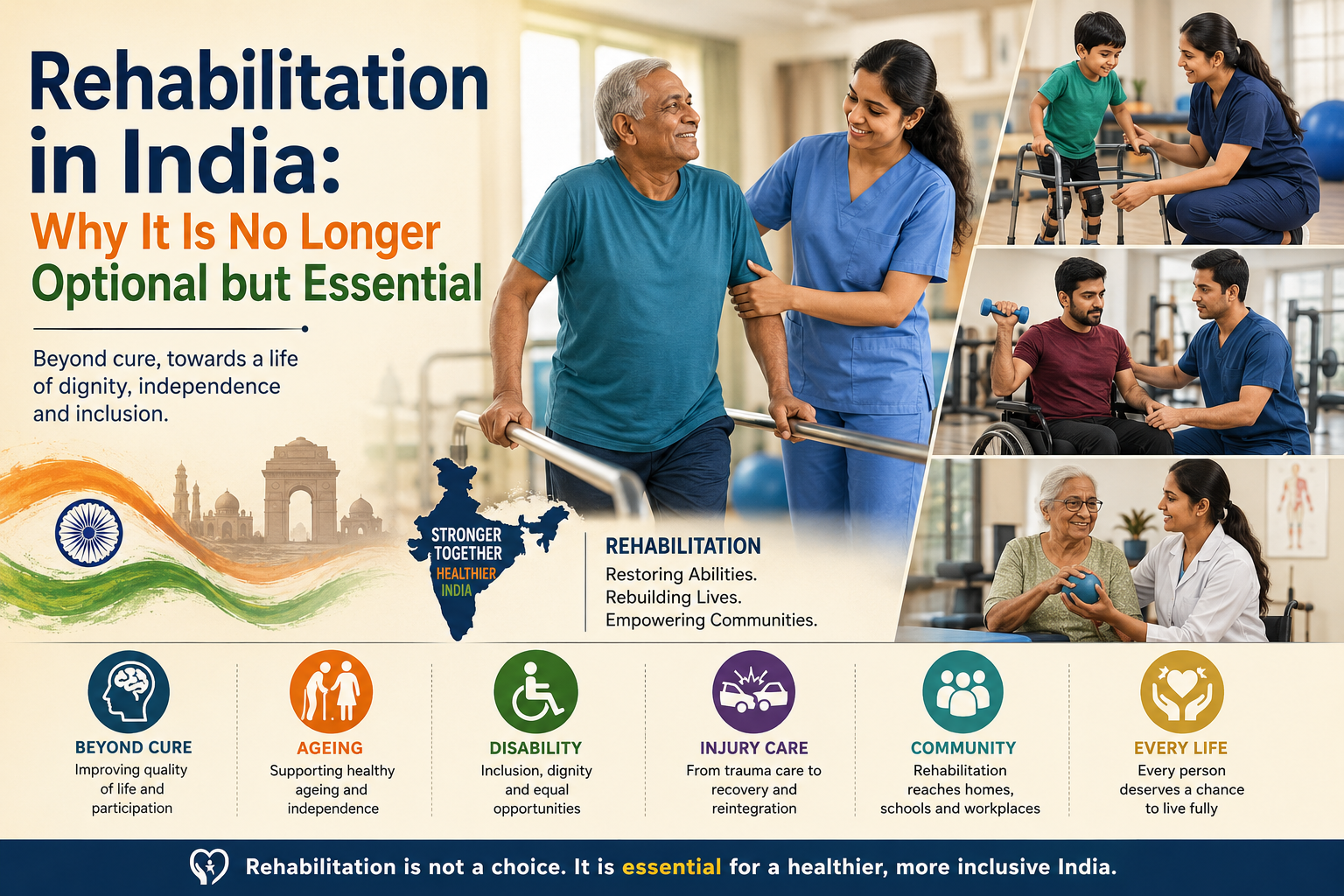
Rehabilitation in India: Why It Is No Longer Optional but Essential
There was once a time in India’s history of healthcare when “survival” became synonymous with success. Making it through a stroke, an accident, a complicated birth and delivery, or anything else is considered a victory. Nonetheless, it is merely the beginning of your life’s journey to health and optimal condition.
What should you do when you leave the hospital?
Who will assist a stroke survivor in recovering her mobility?
How will we ensure that a child with cerebral palsy knows how to speak?
How are we going to make sure that the accident survivor gets back on track at work?
This is the role played by rehabilitation medicine - a key component of modern healthcare. India has undergone a subtle but radical change in its epidemiology. It now has non-communicable diseases, trauma, ageing, and chronic disease in large numbers. Rehabilitation medicine now forms an important partof the Indian healthcare landscape.
Beyond Cure: What Rehabilitation Really Means
Rehabilitation does not end with the exercise regimen assigned by the health practitioner.
Rehabilitation, to put it simply, involves the restoration of lost functions, the gaining of confidence, and participation in society while still suffering from illness.
Rehabilitation differs from the treatment of any medical condition. Treatment addresses the issue of overcoming the disease, while rehabilitation addresses the question of coping with it.
According to the World Health Organisation, rehabilitation is one of the key components of universal health coverage. This view of rehabilitation has been prompted by changes in global perception: health care is no longer evaluated simply interms of mortality rates. Now, health care is required to assist the patient in getting back to their daily routine life, either at home or workplace.
Rehabilitation enables the patient to:
• Become ready for schooling
• Regain independence
• Adjust to living and working with chronic conditions
• Keep mobile and reduce risks of falling
It is not confined to the hospitals alone. It reaches beyond the hospital setting to include the homes, workplaces, schools, and community.
On a global scale, almost one in every three people will need rehabilitation at some stage in their lives as per the WHO.
With populations ageing worldwide and a higher prevalence of non-communicable diseases, the trend seems to be increasing.
In the Indian scenario - characterised by an increased prevalence of both non-communicable disorders and injuries - the need for rehabilitation is no longer an occasional requirement for some people but an essential health service for many.
India’s Changing Health Landscape
1. Rise of Non-Communicable Diseases
These diseases have become the predominant causes of ill-health in India. Cardiovascular diseases, diabetes mellitus, respiratory illnesses, and cancer together contribute to over 60% ofthe total mortality in the country. However, death is only one side of the equation. Stroke patients can suffer from paralysis or speech disorders. The complications associated with diabetes include peripheral neuropathy or amputation of limbs. Patients who undergo cancer treatment can develop disabilities due to the disease. Lack of access to rehabilitative services for patients will result in long-term dependence and unemployment.
2. An Ageing India
The population in India is ageing faster than ever before.
By 2030, around one in five individuals in India would have crossed sixty years of age as per the National Health Profile. As people age, they experience the onset of musculoskel etaldisorders, immobility, loss of balance, and cognitive decline. Geriatric rehabilitation, which entails fall prevention, joint manipulation, balance training, and cognitive rehabilitation, is now considered essential.
However, such facilities are not available outside urban hospitals. If the ageing population lacks rehabilitation facilities, there will be an increase in the ratio of dependency, caregiver stress, and government spending.
3. Injuries and Road Traffic Accidents
Injuries from road accidents are amongst the highest in India in terms of prevalence. Patients usually have to go through prolonged physiotherapy and prosthesis treatments in addition to psychological therapy. If not supported by rehabilitation, trauma care will be incomplete. Patients would live their lives disabled, while their families would bear economic burdens.
4. Musculoskeletal Diseases and Casual Workers
Back pain, osteoarthritis, and work-related injuries are some of the major contributors to DALYs in India. It may not be in news headlines, but these diseases quietly impair the economic performance of many Indians. To the casual workforce - such as the Indian construction industry, farming, and other manufacturing industries - musculoskeletal diseases mean less earnings and even job loss.
Disability and Development:
The Connectedness of Two Concepts Based on the Census of India 2011 figures, more than 26 million people have disabilities in India. It is estimated that the actual number is likely to be much higher because of underreporting. Some observations are noteworthy:
• Approximately 70-80% of peoplewith disabilities are located in rural settings.
• Locomotor impairments are the most prevalent form.
• Illiteracy and unemployment still exist among disabled people. Disability causes
poverty, and vice versa, because the cycle continues in such a way that when there is poor rehabilitation in the childhood years, there is poor learning and poor employment opportunities; therefore, leading to poverty. Effective rehabilitation can bring an end to this chain reaction.
Policy Architecture: Foundations Laid, Gaps Remain
A lot of groundwork in legal termsand institutions has been done in India.
The Persons with Disabilities (Equal Opportunities, Protection of Rights and Full Participation) Act (4) strengthened the rights of disabled persons. Inclusiveness was their priority. The Department of Empowerment of Persons with Disabilities works towards empowering disabled persons.
Important institutions are:
• National Institutes focused on different disabilities
• District Disability Rehabilitation Centres (DDRCs)
• ADIP Scheme for assistive devices
• Universal Disability ID (UDID)
• Ayushman Bharat integration
On a global scale, the World Health Assembly passed Resolution WHA76.6 calling for strengthening rehabilitation in health care systems.
The embracing of these approaches by India is quitepositive. However, challenges remain:
• Imbalanced distribution across districts
• Shortage of workforce
• Concentration of services in urban areas
• Poor data integration
• Variability in standards
Infrastructure is in place. Scaling up and standardisation are the future paths to take.
Challenges in the Workforce
Rehabilitation is a manpower intensive process. Yet, there exist acute shortages in India:
• Physiotherapists per million
• Occupational therapists
• Speech and language pathologists and neurological therapists
Training institutes are located primarily in urban areas. The challenge lies in the retention of personnel inrural areas owing to poor infrastructure and a lack of growth prospects. Unless this challenge can be met, the objectives set out by the policy may remain a dream.
Urban vs Rural Context
While the majority of individuals with disabilities live in the rural setting, most of the sophisticated rehabilitation facilities are situated in urban settings.
Some challenges include:
• The cost of transport
• Awareness among the masses
• The issue of social stigmatisation
• Inadequate referral processes
A potential solution could involvethe application of Community-Based Rehabilitation which entails the empowerment of locals and the family members. However, continued funding and standardisation are necessary.
A technological solution includes tele-rehabilitation, but the challenges of internet connectivity need to be met at the same time.
Why Rehabilitation is a CSR and Policy Issue
The issue of rehabilitation touches upon many aspects of development, as far as CSR and policy go:
1. Economic Productivity
Rehabilitation increases productivity and ensures independence from welfare.
2. Inclusive Education
Rehabilitation at an early stageallows persons with disabilities to study in mainstream schools.
3. Livelihood Security
Rehabilitation provides vocational skills that increase employability.
4. Ageing Issues
Geriatric rehabilitation helps cuthealthcare expenses in the long run.
5. Social and Equity Issues
Accessible rehabilitation ensuresdignified treatment.
Some possible avenues for strategic CSR investments include:
• District-level rehabilitation centers
• Innovative assistive devices
• Skills development for rehabilitation professionals
• Tele-rehabilitation experiments
• Educational campaigns
There are clear social gains to be made from investments in rehabilitation.
References
- World Health Organization. Rehabilitation 2030: A Call for Action. 2017.
- Ministry of Health and Family Welfare, Government of India. National Health Profile.
- Census of India. Data on Disability. 2011.
- Rights of Persons with Disabilities Act. Government of India, 2016.
- World Health Assembly. Resolution WHA76.6 on Strengthening Rehabilitation in Health Systems, 2023.
https://www.who.int/docs/default-source/documents/health-topics/rehabilitation/call-for-action/rehab2030meetingreport_plain_text_version.pdf
https://cbhidghs.mohfw.gov.in/publications/national-health-profile
https://www.indiacode.nic.in/bitstream/123456789/15939/1/the_rights_of_persons_with_disabilities_act%2C_2016.pdf
https://www.mospi.gov.in/sites/default/files/publication_reports/Disabled_persons_in_India_2016.pdf?download=1
https://apps.who.int/gb/ebwha/pdf_files/WHA76/A76_R6-en.pdf