
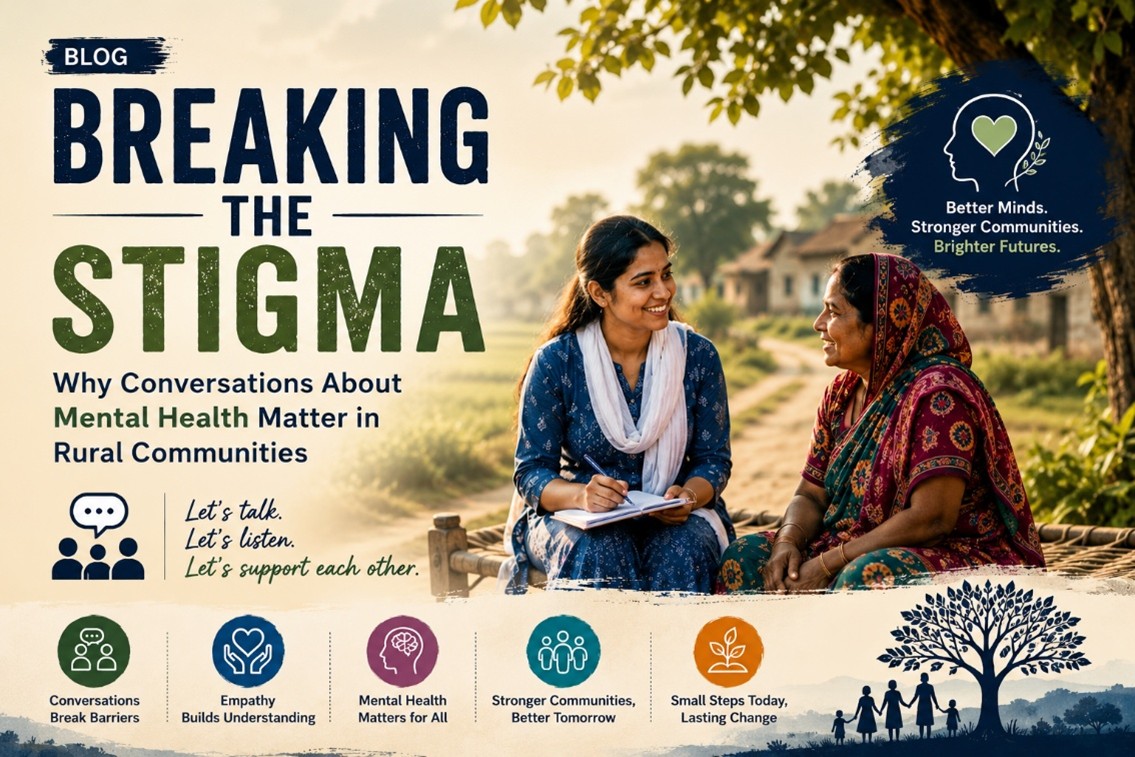
Breaking the Stigma: Why Conversations About Mental Health Matter in Rural Communities
India has approximately 0.75 psychiatrists, 0.07 psychologists, and 0.07 psychiatric social workers per 100,000 population, highlighting why strengthening community-based support systems is essential. Nearly 1 in every 8 people globally (around 970 million people) lives with a mental disorder. Although mental health is becoming more widely acknowledged as an essential part of total wellbeing, it is still one of the most neglected parts of rural development. Depression and anxiety alone cost the global economy an estimated US$1 trillion every year in lost productivity. Access to livelihoods, healthcare, education, and sanitation has improved significantly, but mental health is frequently given far less consideration. In many rural communities, conversations about mental health are still clouded by stigma, misinformation, and silence, preventing individuals from accessing the support they need.
Mental health is not just a healthcare issue it is a development issue. It effects educational attainment, workforce productivity, family connections, community participation, and economic resilience. Attempts to attain inclusive and sustainable development will be unfulfilled if mental health is not addressed.
Understanding the Rural Reality
The difficulties that come with living in a rural area can have a big impact on one's mental health. Persistent stress and worry are frequently brought on by financial instability, reliance on agriculture, climate-related uncertainty, unemployment, migration, debt, and restricted access to necessary services. India is home to nearly 65% of its population living in rural areas, where access to specialised mental healthcare remains extremely limited. The country has less than one psychiatrist per 100,000 population, far below the WHO recommendation, leaving millions without timely care.
Women often manage social and economic injustices while taking on a variety of tasks. While elderly persons may feel lonely as younger family members move to cities in pursuit of greater opportunities, young people confront increasing demands associated to school, work, and uncertain futures. Depression, anxiety, substance abuse, and other mental health issues that frequently go undiagnosed and untreated can be exacerbated by these situations.
There is a cyclical relationship between poverty and mental health. Poverty and social exclusion can exacerbate mental health outcomes, and poor mental health can limit a person's capacity to work, learn, and engage in communal life. Recognizing mental health as a key component of rural development is necessary to break this cycle.
The Weight of Stigma
Despite growing awareness, stigma remains one of the greatest barriers to mental healthcare in rural India. Mental health conditions are often misunderstood or dismissed as a sign of personal weakness, lack of resilience, or even supernatural influence. Fear of judgement, discrimination, or social exclusion discourages many individuals and families from seeking professional help.
As a result, people experiencing emotional distress frequently remain silent, delaying treatment until their condition becomes more severe. Families may also hesitate to discuss mental health concerns openly due to concerns about social reputation or community perceptions.
Reducing stigma begins with normalising conversations around mental health. Just as communities openly discuss maternal health, child nutrition, or infectious diseases, mental well-being must also become a topic that can be discussed without fear or shame.
Why Conversations Matter
Perceptions can be changed through dialogue. Open discourse about mental health helps replace myths with understanding, develops empathy, and reassures individuals that getting help is a show of strength rather than weakness.
Community institutions including schools, self-help groups, Panchayats, youth clubs, and village health committees can become safe spaces where mental well-being is openly discussed. ASHAs, Anganwadi Workers, Auxiliary Nurse Midwives (ANMs), teachers, and community volunteers are examples of frontline workers who are in a good position to spot early indicators of distress, offer basic psychosocial support, and put people in touch with the right services.
Early help-seeking behaviour can be greatly enhanced, and the burden of untreated mental health disorders can be decreased by fostering an atmosphere where people feel heard, respected, and supported.
Integrating Mental Health into Development Programmes
It is not appropriate to approach mental health as a stand-alone intervention. Instead, it should be integrated across development projects to enhance both social and economic effects. Every US$1 invested in scaling up treatment for depression and anxiety generates approximately US$4 in improved health and productivity, making mental health one of the highest-return investments in public health and development.
To help people deal with economic instability, livelihood initiatives can include peer support systems, stress management classes, and financial counselling. Programs for school instruction can help children and adolescents develop life skills, emotional well-being, and early detection of mental health issues. Initiatives for women's empowerment can include safe locations for talking about emotional difficulties, support groups, and counselling services. In a similar vein, routine mental health screening and referral channels can be incorporated into health and nutrition programs in addition to the current mother and child health services.
An integrated approach acknowledges the strong connections between mental health and social inclusion, gender equality, education, livelihoods, and nutrition. Developing oneself frequently helps to improving the others.
Recommendations
Addressing mental health in rural communities requires a coordinated, multi-sectoral approach that extends beyond the healthcare system. Governments, civil society organisations, researchers, development practitioners, educational institutions, and community leaders all have a role to play in creating an environment where mental well-being is recognised as a development priority.
Key actions include:
• Integrate mental health into development programmes: Embed mental well-being within initiatives focused on health, education, livelihoods, nutrition, and women's empowerment to address the interconnected nature of development challenges.
• Strengthen primary healthcare services: Equip PHCs, CHCs, and Health and Wellness Centres with trained personnel, screening tools, counselling services, and referral mechanisms to improve access to mental healthcare.
• Build the capacity of frontline workers: Train ASHAs, ANMs, Anganwadi Workers, teachers, and community volunteers to recognise early signs of mental health concerns and facilitate timely support and referrals.
• Promote awareness and reduce stigma: Conduct culturally sensitive awareness campaigns through schools, self-help groups, Panchayats, and community platforms to encourage open dialogue and challenge misconceptions surrounding mental health.
• Expand access through innovative approaches: Leverage tele-mental health services, digital platforms, and community-based counselling models to reach underserved populations where specialist services are limited.
• Prioritise vulnerable groups: Develop targeted interventions for adolescents, women, older adults, persons with disabilities, and marginalised communities, recognising their unique mental health needs.
• Strengthen research and evidence generation: Invest in research and programme evaluations to better understand rural mental health challenges, identify effective interventions, and support evidence-based policymaking.