

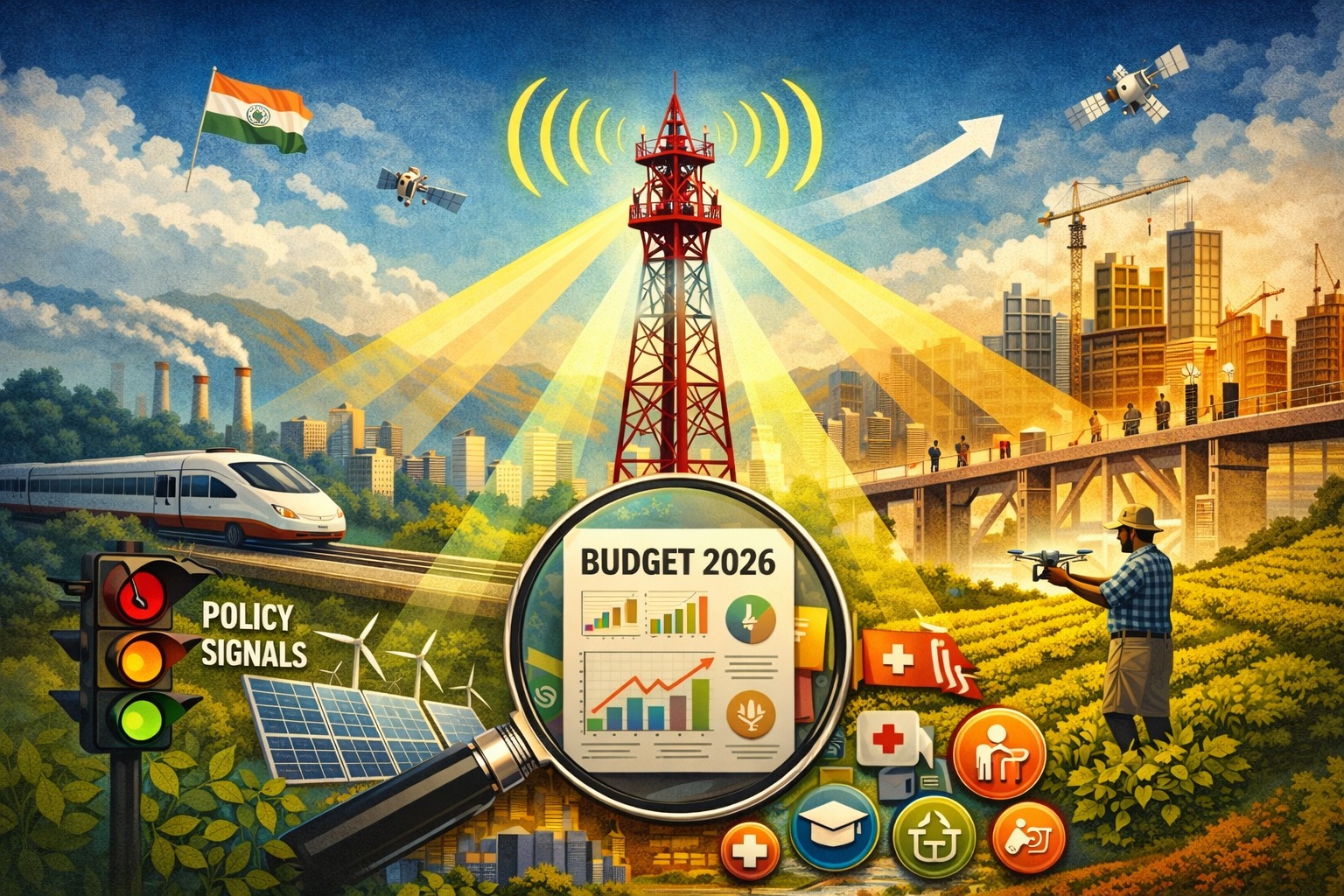
Budget 2026 as a Signal System: What It Reveals About the Future of Development Practice in India
Union Budget 2026–27 is best read not as a ledger of allocations, but as a signal system. It does not speak loudly through dramatic expansions ofsocial-sector line items; instead, it communicates quietly through institutional design, fiscal posture, and the choice of reform levers. For researchers, this makes Budget 2026 unusually interesting. It offers a window into how the Indian state is attempting to reconcile three often competing imperatives: fiscal consolidation, infrastructure-led growth, and sustained investment in human capacity.
Inthat sense, Budget 2026 is not simply a financial document it is a governance document. It tells us less about how much the state will spend on development, and more about how development is expected to be delivered, evaluated, and governed in the coming years.
Reading the Budget Through State Intent
The government’s own framing three “kartavya” or duties, focused on accele rating growth, building people’s capacity, and ensuring inclusion matter sanalytically. It signals an intent to collapse the traditional distinction between economic policy and social policy. Development, in this framing, is not a compensatory or charitable activity that follows growth; itis embedded with in growth strategy it self.
For researchers, this raises a key interpretive question: what happens to development delivery when it is absorbed into economic logic? Budget 2026 provides early clues. Across sectors, the emphasis is not on expanding schemes,but on tightening systems through platforms, compliance reform, out come frame works, and institutional convergence. This is development under constraint, but also development by design.
The Macro Backdrop: Development Within Fiscal Discipline
Atthe macro level, the budget continues a familiar but consequential balancing act. Capital expenditure remains the growth engine, while the fiscal deficit is nudged downward. Total expenditure and receipts follow apredictable consolidation trajectory, suggesting that the era of rapid discretionary expansion in social spending is unlikely to return in the near term.
Why does this matter for development researchers? Because fiscal discipline shapes not just volumes of spending, but administrative behaviour. When ministries and states operate under tighter fiscal envelopes, pressure shiftstoward efficiency, targeting, and demonstrable outcomes. This, in turn, reshapes the demand for evidence, monitoring, and third-party capabilities.
Historically, periods of fiscal tightening have coincided with greater reliance on non-state actors for last-mile delivery, innovation, and feed back loops. Budget 2026 fits this pattern. The implicit message is clear: the state will continue to invest, but it expects delivery systems public andnon-public alike to do more with less.
A Quiet but Consequential Shift: Tax Architecture and the Nonprofit State
Perhapsthe most structurally significant development-sector implication of Budget 2026lies not in expenditure, but in administration. The transition to the New Income Tax Act regime marks a reset in how non profit entities are regulated, monitored, and integrated into the formal fiscal system.
For researchers of civil society and governance, this is a criticalinflection point. Simplification of rules, greater clarity around mergers, and more nuanced treatment of compliance breaches suggest an attempt tomove from a punitive regulatory posture to a calibrated one. At the sametime, the emphasis on filing discipline, registration hygiene, and enforcement signals that informality will no longer be tolerated asa default mode of operation.
This dual movement simplification combined with tighter expectations effectively redefines what organisational capacity means in the non profit sector.Compliance is no longer peripheral overhead; it becomes core infrastructure.The likely outcome is a gradual stratification of the NGO ecosystem, where entities with stronger legal, financial, and governance systems gaindis proportionate access to CSR funding and government partnerships.
Sectoral Signals: Where Demand Is Likely to Grow
Budget 2026’s programme-level signals are subtle but consistent. Rather than announcing new flagship schemes, the budget reinforces trajectories in skills, urban systems, mental health, and digitally mediated agriculture. Each of these areas is characterised by complexity, interdependence, and the need for intermediating institutions.
The proposal to institutionalise attention to the education-to-employment pipe line, including the impact of AI on jobs, reflects a shift away from static notions of skilling. Employability is increasingly framed as a dynamic system problem linking education, labour markets, migration, and enterprise.
Urban development through City Economic Regions marks another important shift. Development attention is moving from administrative units to functional economic geographies, reshaping how inclusion, service delivery, andlivelihoods are conceptualised.
Mental health emerges as an area where the budget moves from projectisation toward institution-building, signalling recognition of mental health as a systemic public good rather than a niche concern.
Inagriculture, AI-enabled advisory platforms highlight a familiar gap between technological capability and social adoption. For researchers, the key question slie in trust, usability, and unequal access, not algorithms.
CSR and the Logic of Convergence
Al though CSR does not dominate budget rhetoric, Budget 2026 is likely to shape CSR behaviour indirectly but powerfully. As public systems emphasise outcomes, platforms, and convergence, CSR actors increasingly align with these priorities to reduce risk and enhance scale.
For researchers studying private development finance, this reinforces alonger-term trend: CSR is moving away from fragmented activities toward multi-year, outcome-oriented, and co-financed models. Alignment with publicsystems lowers transaction costs and increases institutional legitimacy but it also narrows the space for experimentation.
Changing Practice: What This Means on the Ground
For development practitioners, the implications of Budget 2026 will be felt less in announcements and more in everyday practice. Public systems literacy understanding schemes, platforms, and institutional incentives become sessential professional knowledge.
Simultaneously, pressure for evidence and metrics intensifies. Dashboards and in dicator sprolife rate, raising the risk that measurement substitutes meaning. Thisis where researchers play a critical role in protecting analytical rigourwithout losing field realism.
Finally, compliance and partnership costs become unavoidable programme expenses. Audit readiness, data protection, and documentation are no longer optionaladd-ons; they are part of the cost of legitimacy.
Concluding Reflection: Development as Governance, Not Expenditure
Budget 2026 does not expand the social sector by spending more; it reshapes it by governing differently. It treats development less as a matter of allocation and moreas a matter of architecture of systems, incentives, and institutional behaviour.
For researchers, this makes Budget 2026 a rich site of inquiry. The central question it poses is subtle but profound: can development remain inclusive, adaptive, and grounded when it is increasingly required to be efficient,compliant, and system-aligned?
Budget 2026 does not answer this question, but it makes it unavoidable.