
India’s School Education System and the Quiet Power of Corporate Social Responsibility (CSR)in Shaping Its Future
Education in India has always carried more weight than just academic learning. For generations, schooling has represented hope, mobility, and the promise of a better life. Parents across villages, towns, and cities place enormous faith in education as a pathway out of poverty and social exclusion. Yet, despite decades of policy reforms and growing investments, the Indian school education system continues to face serious challenges that threaten this promise.
India has achieved near universal enrolment at the primary level. Schools exist in most habitations, and enrolment numbers appear encouraging on paper. However, access has not translated into learning. Large numbers of children complete several years of schooling without acquiring basic reading, writing, or numeracy skills. This gap between schooling and learning lies at the heart of India’s education crisis.
Government schools, which educate the majority of Indian children, especially those from disadvantaged communities, remain under strain. Many struggles with inadequate infrastructure, teacher shortages, limited academic support, and outdated teaching practices. Teachers often carry heavy administrative responsibilities that leave little time for classroom innovation. Digital learning, which gained urgency after the pandemic, has expanded unevenly, with rural and low income communities facing persistent access barriers.
The result is a growing trust deficit. Families who can afford alternatives increasingly turn to private schools, even when quality is uncertain. Those who cannot are left behind, reinforcing cycles of inequality that education was meant to break.
Why Education Cannot Be the Government’s Responsibility Alone
Public education remains the responsibility of the state, and rightly so. However, the scale and complexity of India’s education challenges demand collective action. Government budgets are stretched, systems are large, and reforms take time to translate into classroom change. This reality has opened space for non-state actors, particularly the corporate sector, to play a constructive role.
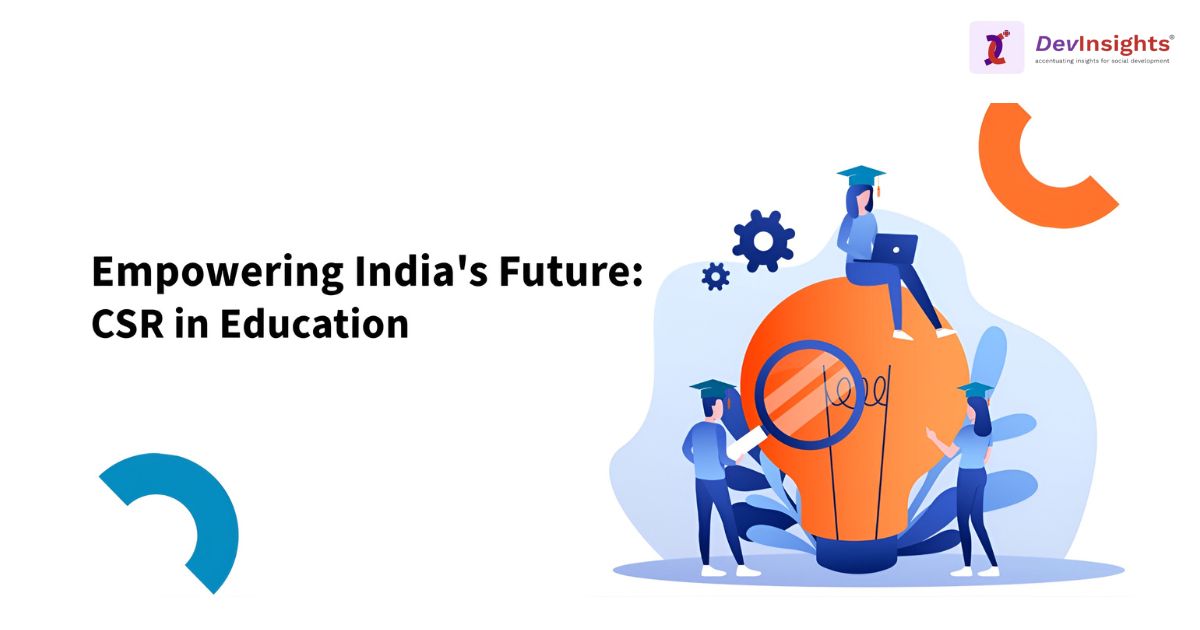
Corporate Social Responsibility in India moved from voluntary philanthropy to a formal mandate under the Companies Act, 2013. Education quickly emerged as one of the most preferred CSR sectors.
Thousands of crores are now spent annually on education related initiatives. Yet, the impact of this spending varies widely.
A significant portion of CSR investment has focused on visible outputs such as school buildings, toilets, scholarships, and learning materials. These interventions are necessary and often valuable. However, they rarely address the deeper issues that shape learning outcomes. Quality teaching, school leadership, curriculum relevance, and student engagement remain under addressed areas.
For CSR to make a lasting difference, it must evolve from one time interventions to long term partnerships that strengthen education systems from within.
From Charity to Capacity Building
Education is not a short term project. It is a continuous process shaped by classrooms, teachers, school leaders, parents, and communities. CSR initiatives that recognise this complexity tend to be more effective.
Teacher capacity building is one such area where CSR can create deep impact. Well designed teacher training, mentoring support, and exposure to new pedagogical methods can significantly improve classroom practices. Similarly, investments in school leadership and governance help ensure that improvements are sustained beyond the life of a project.
Technology offers another opportunity, but only when introduced thoughtfully. Digital tools must be aligned with curriculum goals and teacher capacities. Simply providing devices or platforms without training and follow up often leads to low usage and limited impact.
What distinguishes effective CSR programmes is not the size of investment, but the quality of design, implementation, and learning.
The Role of Evidence in Strengthening CSR in Education
As CSR spending grows, so does the need for evidence. Education outcomes are complex and long term. Counting classrooms built or students enrolled does not capture whether children are actually learning better.
This is where research, monitoring, evaluation, and learning become critical. Evidence helps organisations understand what works, what does not, and why. It supports better decision making and accountability, both to communities and to funders.
In this space, organisations like DevInsights play a vital role. DevInsights is an India based research and advisory organisation that works across education, livelihoods, health, gender, governance, and climate action. Through rigorous research, mixed method evaluations, and learning focused approaches, DevInsights supports governments, foundations, CSR teams, and development organisations to design and strengthen social programmes based on evidence.
In the education sector, DevInsights has worked on school education, teacher development, digital learning initiatives, and system strengthening efforts across multiple states. By combining quantitative data with qualitative insights from teachers, students, parents, and administrators, DevInsights helps stakeholders move beyond assumptions and focus on real outcomes. This emphasis on evidence is increasingly essential as CSR moves toward outcome based and impact driven approaches.
CSR as a Partner in Educational Equity
One of the strongest arguments for corporate engagement in education lies in equity. Government schools remain the primary education providers for rural, tribal, and urban poor communities. Targeted CSR interventions can help address structural gaps that disproportionately affect these groups.
However, equity driven CSR requires intentional choices. It means investing in underserved geographies rather than only areas with strong corporate presence. It means supporting first generation learners, girls’ education, children with disabilities, and migrant communities. It also means aligning interventions with government priorities to avoid fragmentation and duplication.
CSR initiatives that are informed by strong contextual understanding and local partnerships are more likely to reach those who need support the most.
Professionalising CSR for Better Education Outcomes
Another shift underway in India’s CSR landscape is the growing role of dedicated CSR professionals. With CSR spending mandated, responsibility has moved from senior leadership to implementation teams. This shift requires new skills, including programme design, stakeholder engagement, monitoring, evaluation, and adaptive learning.
Research on CSR in India highlights the importance of management education and capacity building for CSR professionals. When CSR teams understand education systems deeply and are equipped to manage complexity, interventions become more strategic and effective.
Here again, DevInsights contributes by supporting organisations with capacity building, learning workshops, and advisory services. By helping CSR teams interpret data, reflect on findings, and refine strategies, organisations like DevInsights strengthen the overall quality of CSR engagement in education.
Collaboration Is the Way Forward
India’s education challenges cannot be solved by any single actor. Government policies set direction and scale. Schools and teachers shape daily learning experiences. Communities provide accountability and local knowledge. Corporates bring resources, technology, and management expertise. Research organisations contribute evidence and learning.
When these actors work in silos, impact remains limited. When they collaborate with shared goals and clear roles, the potential for transformation increases significantly.
Successful CSR initiatives in education often operate as partnerships with education departments, NGOs, and research institutions. They invest in long term engagement, continuous learning, and system level change rather than short term visibility.
Reference-
Role of CSR (Corporate Social responsibility in promoting education
-https://www.ijmrsetm.com/admin/img/11_ankita-1%202020.pdf
Rethinking the role of managment education in developing a new locus of CSR responsibility- an indian case study
-https://www.emerald.com/jwam/article/9/1/51/249743/Rethinking-the-role-of-management-education-in
Government Schools in India: Challenges, Progress, and Educational Equity
-https://ijsrem.com/download/government-schools-in-india-challenges-progress-and-educational-equity/
Beyond Corporate Social Responsibility: A Role for Corporate India in Rural Primary Education
-https://journals.sagepub.com/doi/abs/10.1177/2277975213477265