
AI in Primary Healthcare: Promise, Pitfalls, and Ethics in Rural India
Artificial intelligence is quickly entering the global health sector, promising faster diagnosis, smarter systems, and more efficient care. In India, where the primary health care system is known to function under resource constraints, AI is being considered a potential force multiplier. Ranging from decision support systems for frontline health workers to predictive analytics for disease surveillance, its applications are growing rapidly
However, in rural settings, the healthcare system is not merely a technical system. It is also a relational, trust-based, and socially informed system. The challenge is not whether AI can transform the primary healthcare system in rural India but how it can be done.
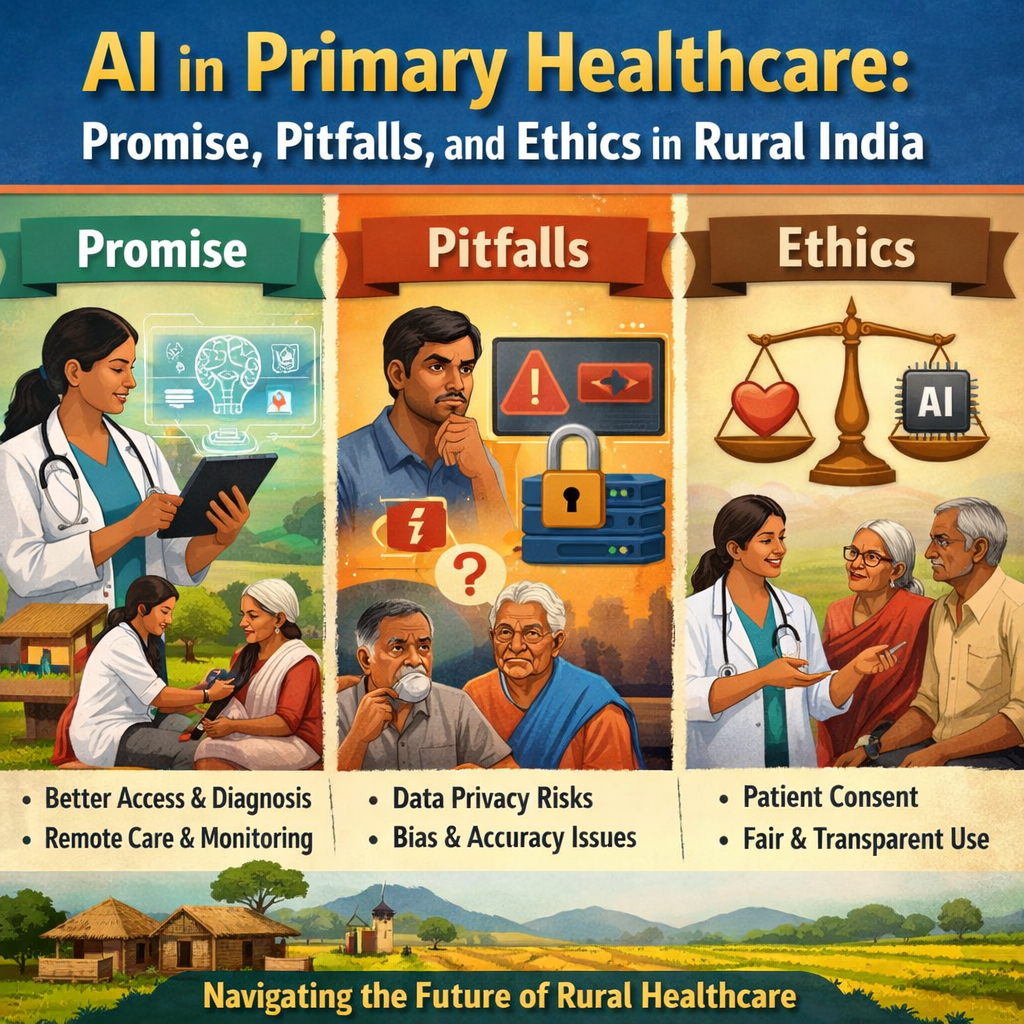
The Promise: Extending Capacity at the Last Mile
Primary healthcare facilities in India often do not have enough trained doctors, equipment to diagnose diseases and specialist support. 69 Percent of Indias population lives in rural areas but many qualified doctors are in urban areas (Office of the Registrar General & Census Commissioner 2011, Patel et.al, 2015). There are not workers at the primary and secondary care levels, and the government says that many Community Health Centres do not have enough specialists. In some states they are missing 70 to 80 percent of the specialists they need which was reported by Ministry of Health and Family Welfare in 2023. In these situations, AI-enabled tools can help by making frontline providers more capable than replacing them.
AI can help community health workers find out if a pregnancy is risk or if a child is sick or if someone has an early sign of a non-communicable disease. This is very important because non-communicable diseases cause two-thirds of all deaths in India according to the World Health Organization in 2023. AI systems that use images can help screen for diseases like retinopathy or skin disorders in areas where specialists are not available. Studies in India have shown that AI-supported retinal screening is very accurate. It is correct 85 to 90 percent of the time which's comparable to a specialist’s diagnosis (Dey et.al, 2024). AI can also help predict when a disease will break out by finding patterns in health data, which is very important in areas where it is hard to watch for diseases and get lab tests.
In these situations, AI can be like a pair of eyes in the primary care system helping providers make better decisions and catch problems earlier. If AI is designed correctly, it can reduce delays in diagnosis help share tasks and improve care.
The Pitfalls: Technology Without Context
Despite its potential, AI in rural healthcare risks replicating long-standing patterns of technological mismatch. Most digital health solutions are designed based on urban data, standardized assumptions about healthcare, and infrastructure that do not align with rural settings. When these solutions are applied in resource-poor settings, they can lead to inaccurate results or fail to integrate with existing systems.
Infrastructure challenges also remain important. Intermittent power, poor connectivity, and limited ability to maintain devices can affect AI-based services. Healthcare workers already struggling with high workloads may face additional strain if solutions are poorly designed or not well adapted to local conditions.
The Ethical Questions: Data, Bias, and Agency
The integration of AI into rural healthcare systems also has important ethical considerations that go beyond technical performance. Data privacy is a deal. People who live in areas often do not know how their health information is collected, stored and used. The process of getting permission from people maybe done just to follow the rules than making sure people understand what is happening. We need to make sure that people in these communities know what is going on with their health information and have control over it.
Algorithmic bias is another problem. If artificial intelligence models are trained using information from people who're not like the people in rural areas, they may not work very well for those communities. This can lead to unfairness in how people are diagnosed or treated. For example, if the models are trained on data from cities, they may not be accurate for people who live in areas or are part of tribal populations.
We also need to think about who's responsible when something goes wrong. When a computer program helps to decide about someone’s health it can be hard to know who is to blame if something bad happens. We need to have rules in place so that we know what to do when a computer program is used to make a health decision. This way we can make sure that computers are used to help doctors and nurses than replacing them.
Trust is very important when it comes to healthcare in areas. People, in these communities often trust their health workers because they have gotten to know them over time. If computer programs are used in a way that seems secretive or forced upon people, it can damage the trust that people have in their healthcare providers. We need to make sure that computer programs are used in away that's transparent and helpful so that people can continue to trust their healthcare providers.
The Way Forward: Responsible and Contextual AI
For AI to meaning fully strengthen primary healthcare in rural India, its development and deployment must be grounded in public health principles rather than purely technological ambition.
First, we need to make sure that AI tools are designed with the people who use them like frontline workers and others in the health system. This way these tools will fit in with how things really done and will not be too hard to use. If we can make tools that make their jobs easier and help them make decisions, they will be more likely to use them and keep using them.
Second, when we are training AI models, we need to use information from all sorts of people including those who live in areas and those who are often left out. This will help make sure that the tools we make are fair and work well for everyone. We also need to keep checking that these tools work in life not just in theory.
Third, we need to have rules in place for how we handle data at both the national and state levels. This means being open with people about what we're doing with their information keeping that information safe and making sure someone is responsible if something goes wrong.
Fourth, AI should be part of a plan to make the whole health system better not just something we try out on its own. It works best when we have roads, trained staff, enough medicine and a system to get people the help they need when they need it.
Finally, AI in healthcare should be seen as a way to help the people who are already providing care not as a way to replace them. The goal is to help these caregivers do their jobs better reach people and be more confident in what they are doing all while keeping the personal touch that is so important, in healthcare. We want AI to support the people who are taking care of others not take their place.
Conclusion
Artificial Intelligence holds a lot of promise for making healthcare better in India. This is especially true in areas where there are not doctors and nurses and it is hard to get around. Technology by itself is not enough to fix the big problems or replace a working healthcare system.
The real difference Artificial Intelligence can make depends on how it is adapted to the local area, how fairly it is managed and how much it really helps the doctors and nurses on the ground and the communities they serve. If Artificial Intelligence is used in a way it can help make rural healthcare better by making it more responsive to people’s needs, more fair and more able to withstand challenges. If Artificial Intelligence is used without thinking about the local context it might just be another new idea that does not last and does not help the people who need it the most.
So, the future of Artificial Intelligence in healthcare is not just about having the most advanced technology but about really understanding the people the place and the realities of public health. Artificial Intelligence needs to be used in a way that's sensitive to the needs of rural India and its healthcare system. This is how Artificial Intelligence can really make a difference in healthcare.