

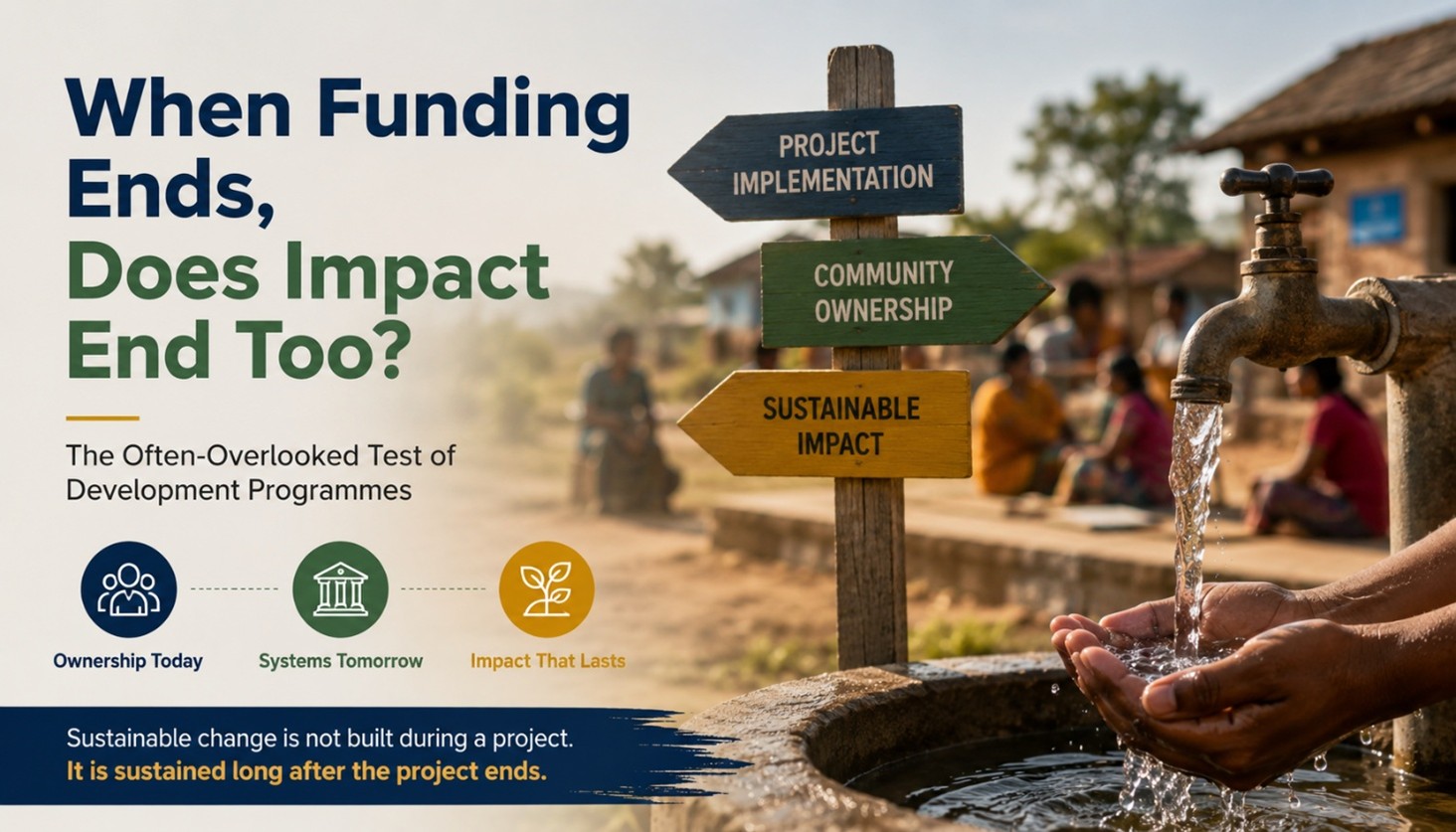
When Funding Ends, Does Impact End Too?
The Often-Overlooked Test of Development Programmes
Introduction: Looking Beyond Project Timelines
In the development sector, success is typically measured within the lifespan of a project. Targets are achieved, activities are completed, and outcomes are documented. By the time a project closes, reports have been submitted, lessons have been captured, and teams have moved on to the next initiative.
Yet some of the most consequential questions emerge only after implementation ends. Does the intervention continue to create value once external support is withdrawn? Do communities still use and maintain the systems introduced during the project? Have local institutions genuinely developed the capacity to carry the work forward?
These questions sit at the heart of sustainability and in most programmes, they are asked far too late.
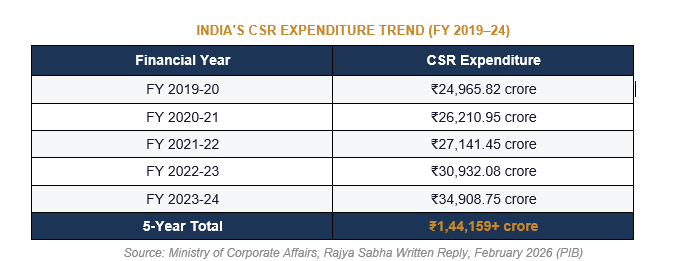
India's development landscape offers a stark mirror for this challenge. Between FY 2019-20 and FY 2023-24, corporate India contributed over ₹1,44,159 crore to CSR activities across 14 development sectors, involving more than 59,633 projectsin FY 2023-24 alone. Yet questions about what these investments produce five years after project closure remain largely unanswered in India's monitoring ecosystem.
When Project Success Doesn't Last
Many development programmes demonstrate strong results during implementation. A water system is installed and functional. Farmers adopt improved agricultural practices. Community groups become active participants in local governance. But sustaining these gains often proves far more difficult than achieving them.
Consider water infrastructure. The Government of India's Jal Jeevan Mission one of the country's most ambitious rural infrastructure programmes explicitly recognised this risk from the outset. Its mission guidelines do not merely focus on installing functional household tap connections; they mandate source sustainability measures as a core programme component, including community-managed operation and maintenance frameworks, greywater management, and water source protection.
As of February 2025, over 15.44 crore rural households roughly 79.74% of the target have received functional tap connections.The more significant test, however, is whether these connections remain functional in 2029, when government field teams are no longer present at the doorstep. The mission's designers understood this, which is why it embedded Village Water and Sanitation Committees (VWSCs) under Gram Panchayats as the post-handover management structure.
This is not a hypothetical concern. It is a well-documented pattern across sectors: infrastructure projects perform well while technical support is available, only to face maintenance gaps once the external team exits. Livelihood programmes report strong participation during implementation, but adoption erodes when continuous handholding ends.
Such outcomes do not always indicate project failure. They point to something more fundamental the distinction between delivering an intervention and ensuring it continues to generate value over time.
Why Sustainability Cannot Bean Afterthought
Sustainability is frequently discussed at the close of a project, framed as an exit strategy. In reality, it must be embedded from the very first day of design.
The NITI Aayog's Social Impact Assessment of CSR in India (DMEO, 2021) noted that a significant share of CSR spending in India has historically been concentrated on asset creation, with relatively weaker investment in institutional and human capacity. Assets depreciate. Capacities compound. This asymmetry is at the root of many sustainability failures.
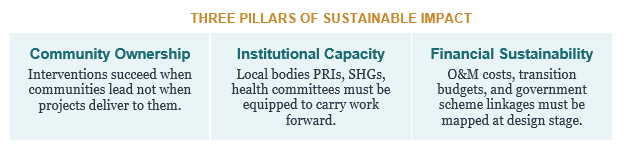
Projects that sustain impact typically share these three characteristics and build them systematically, not incidentally. Community ownership is fostered through participation, not announced at a closing ceremony. Institutional capacity is developed through shared management, not PowerPoint training. Financial sustainability is modelled at design stage, not assumed at closure.
The Role of Ownership
Ownership is one of the strongest predictors of long-term sustainability and one of the hardest things to engineer retroactively. The Jal Jeevan Mission again offers a valuable design lesson: the mission explicitly promotes voluntary ownership among local communities through contributions in cash, kind, or shramdaan (voluntary labour) as a programme design principle not as a good will gesture, but as a structural mechanism.
Communities are far more likely to sustain an intervention when they experience it as their own, rather than as a project delivered to them. This distinction is not semantic. It determines whether local people report a broken handpump as their problem or wait for the project team to notice.
This principle holds equally for CSR-funded programmes in livelihoods, education, and health. The same logic applies to institutions. Panchayati Raj institutions, district health departments, school management committees, and SHGs are far more likely to continue activities they helped design and manage than activities handed to them at a closing ceremony.
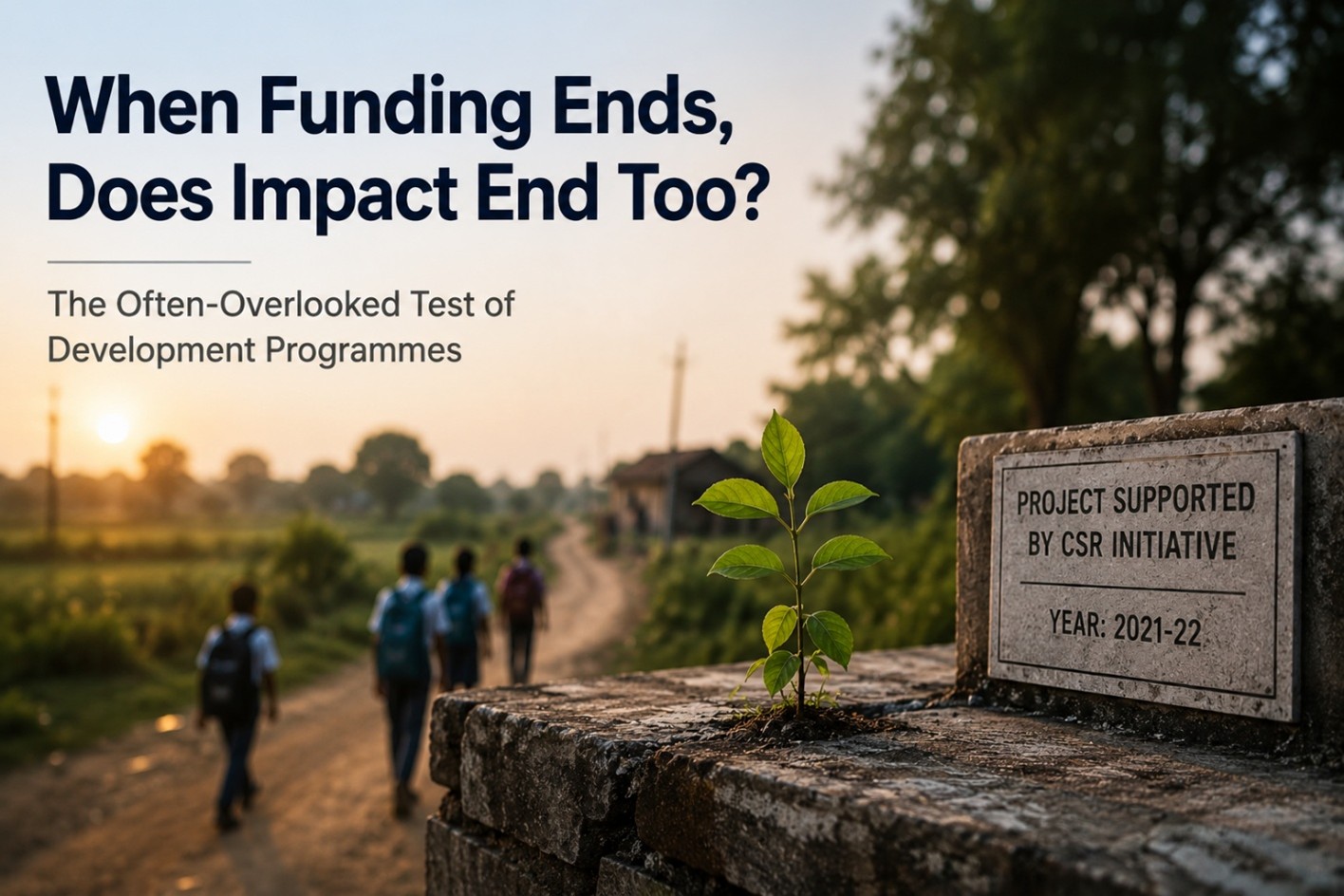
Rethinking Exit Strategies
Exit strategies are often viewed as a final project requirement. In practice, they are among the most important determinants of long-term sustainability.
One way to strengthen sustainability is through convergence with existing government programmes. India’s ecosystem of schemes from PM-KISAN and Ayushman Bharat to MGNREGS and Skill India offer spathways for continuing support beyond project funding. The Ministry of Corporate Affairs' High-Level Committee on CSR (2018) also highlighted the importance of such convergence to avoid duplication and create lasting impact.
Ultimately, an effective exit strategy is notabout ending activities; it is about ensuring that communities and institutions can continue them independently.
Measuring What Happens Next
Impact assessments are most conducted at the end of a project cycle. While valuable, they capture only part of the story the part that coincides with project support.
Some of the most meaningful insights emerge months or years after closure: Has the water system been maintained, or have taps run dry? Are women who received livelihood training still generating income, or did participation end with the stipend? Have community institutions continued to function, or have they become dormant?
India's CSR ecosystem does not yet systematically require post-closure follow-up. Rule 8(3) of the Companies (CSR Policy) Rules, 2014 mandates independent impact assessments for projects above ₹1 crore, but the timing and depth of these assessments vary widely in practice. The CAG's 2024 performance audit of CSR under the Companies Act found that independent verification and post-completion outcome tracking remain inconsistent across implementing organisations.
NITI Aayog's SDG India Index 2023-24 which monitors state-level progress across 113 indicators aligned to the National Indicator Framework tracks where India stands at a point in time. It doesnot tell us how durable those gains are. This gap in monitoring design mirrors the gap in programme design itself.
At DevInsights, our experience across impact assessments, CSR advisory, and community engagement consistently points to one finding: sustainability is not a natural byproduct of good implementation. It requires intentional design, deliberate investment, and a willingness to measure what happens after the applause.
Projects that sustain impact are not those that spent the most. They are those that invested in ownership, built local capacity, and planned their own irrelevance. That last phrase is worth sitting with. The goal of development programming, at its best, is to make the programme unnecessary.
Looking beyond project time lines often reveals insights that traditional reporting cannot capture. It is also where the true value of evaluation begins.
Conclusion: Lasting Change Is Built Through People, Not Projects
India is at a critical juncture. With over ₹34,908 crore committed to CSR in FY 2023-24 alone, the question of durability has never been more relevant. Compliance with the Companies Act has improved markedly. The next challenge is ensuring that compliance translates into impact that lasts.
Projects may conclude. Funding cycles end. Reporting deadlines pass. But communities continue to live in the places where interventions happened longafter teams have moved on.
Lasting change is not built through projects alone. It is built through people, institutions, and systems that continue to thrive once the project is gone.
References & Sources.
[1] Ministry of Corporate Affairs, Govt. of India - Rajya Sabha Written Reply on CSRExpenditure FY 2019-24. February 2026. https://www.pib.gov.in/PressReleasePage.aspx?PRID=2226018
[2] Ministry of Jal Shakti, Govt. of India - Jal Jeevan Mission: Mission Objectives &Sustainability Framework. https://jaljeevanmission.gov.in/about_jjm
[3] PIB, Govt. of India - Jal Jeevan Mission Progress Update, February 2025. https://www.pib.gov.in/PressReleasePage.aspx?PRID=2098651
[4] NITI Aayog / DMEO, Govt. of India - Social Impact Assessment of CSR in India.2021. https://dmeo.gov.in/reports-working/social-impact-assessment-corporate-social-responsibility-csr-india
[5] NITI Aayog, Govt. of India - SDG India Index 2023-24 (PIB Release). https://www.pib.gov.in/PressReleasePage.aspx?PRID=2032857
[6] Ministry of Corporate Affairs, Govt. of India - Report of the High Level Committee onCSR 2018. https://www.mca.gov.in/Ministry/pdf/CSRHLC_13092019.pdf
[7] Comptroller and Auditor General of India (CAG) - Performance Audit on CSR under theCompanies Act, 2013. 2024. https://cag.gov.in/uploads/download_audit_report/2024/07-Chapter-IV-06690d23bdfbc72.95547184.pdf
[8] Companies Act, 2013 - Section 135 & Schedule VII, Ministry of Corporate Affairs.India Code. https://www.indiacode.nic.in
[9] NITI Aayog, Govt. of India - Sustainable Development Goals Division: Mandate &SDG Localisation Framework. https://www.niti.gov.in/divisions/division/sustainable-development-goal