
Beyond Compliance: How ESG Can Transform Healthcare Systems from the Inside Out
There exists an inherent paradoxat the core of modern healthcare services. The very industry that aims to safeguard our health and well-being is among the biggest sources of factors that cause diseases across the globe. Today, the healthcare sector produces 4.4–5.2% of all greenhouse gas (GHG) emissions, which would make it the fifth-biggest emitter if it was considered a nation-state. It is responsible for the production of vast amounts of toxic waste and massive energy consumption, among other negative impacts.
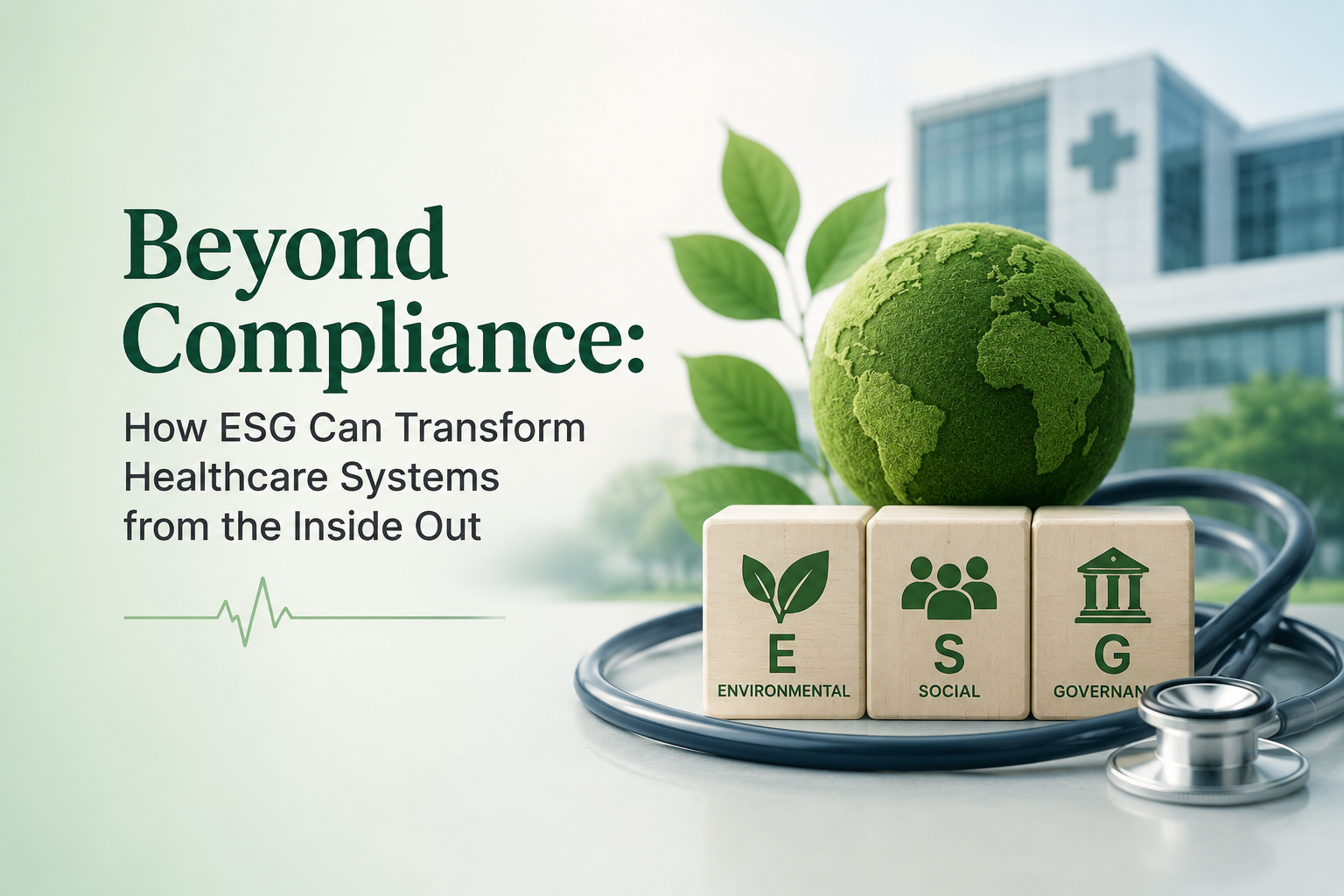
That is why ESG – Environmental, Social and Governance – makes such an exciting tool to change healthcare. Unlike other frameworks that are just a reporting mechanism for companies, ESG in healthcare represents a systemic issue, and it lies in whether or not the institutions taking care of human well-being have accountability on all of the above-mentioned levels.
What ESG Means in a Healthcare Context
The concept of ESG in the healthcare sector acquires its unique definition. In the Environmental aspect, ESG includes emissions produced by the hospital, the treatment and disposal of medical waste, energy consumption, and the impact of drugs used on environmental pollution. The Social part includes health equity, worker welfare, patient safety, and accessibility.
These dimensions are intrinsically linked. Environmental destruction impacts adversely on the healthof populations. Poor social governance means that diseases affect the most vulnerable individuals. Poor institutional governance diminishes faith in medicine and clinical care. ESG in healthcare is not simply a reporting exercise with three distinct categories - it requires systemic change.
The Environmental Case: A Sector Healing at Its Own Expense
Electricity production alone is responsible for about 40% of the emissions by healthcare. The emissions also include the emissions from pharmaceutical logistics, an aesthesia gases, transportation of fleets, and the use of single-use plastics. According to research published in 2024, per capita healthcare emissions increased between 2007 and 2016 in America, Japan, and China .
It is another aspect of crisis. According to the World Health Organization, 15 percent of healthcare wastes canbe considered hazardous; however, in 2021, only 61 percent of hospitals around the globe were able to avail of waste management services. There are rules regarding biomedical waste management in India, including those formulated in 2016 and 2019.
Feasible approaches do exist. In the UK, the NHS became the first national health organization to pledge achieving net-zero, and, as a result, has achieved a 68% reduction in direct carbon emissions from 1990 to date, having saved £47.8 million worth of energy costs alone from 2022/23 onwards. Just one NHS trust has managed to decrease its carbon footprint by 30,000 kg CO₂ equivalent simply by changing from high-GWP anaesthetics to those with a low carbon footprint.
The Social Case: Health Equity as ESG Imperative
The social aspect of ESGs within the healthcare domain is very much practical for India as it involves issues of justice. OOP expenditure still constitutes 39.4% of overall health expenditure up to 2021-22, decreasing from 64.2% over a decade back but still amongst the highest in the world. Several studies indicate that health expenditures throw 32 to 39 million Indians into poverty each year.
The Ayushman Bharat PM-JAY scheme, which offers cashless insurance cover of up to ₹5 lakh annually to around 55 crore individuals, can be considered India's largest social ESG initiative in the health sector. The addition in 2024 of all senior citizens aged above 70 years irrespective of their income is a significant move forward. However, according to an NITI Aayog study, around 30% of people still lack health insurance, who form the "missing middle," neither coveredby PM-JAY nor other insurance programs.
The issue of labor market fairness is no less important. India currently has 0.7 doctors for 1,000 individuals, while the WHO recommends that there be 1 doctor for 1,000 people; there is a skewed distribution across urban and rural areas. An exhausted and clustered labor force will not yield fair social results, no matter what an ESG report says.
The Governance Case: AI, Data, and Accountability
With digitalisation of healthcare, governance ESG issues have gained renewed importance. The guidance issued by WHO in January 2024 on AI ethics in health has pointed out that while there may be different risks associated with each step in the lifecycle of artificial intelligence, privacy and algorithmic bias should not be compromised under any circumstances. The Indian DPDP Act (2023) imposes fresh dutieson healthcare data fiduciaries.
The SEBI framework for BRSR-mandatory for the leading 1,000 companies listed in India from financial year 2022-23-is starting to make healthcare firms consider disclosing their non-financial performance. Yet, there are no clinical measures specific to the healthcare industry, and most hospitals do not fall within the scope of mandatory reporting.
The Path Forward
COP28 Declaration on Climate and Health was signed by more than 120 nations at COP28 in December 2023, with 76 countries signing on with WHO's ATACH, pledging to adopt low-carbon and climatere silient health systems. The framework for healthcare ESG is under construction – unevenly, but unmistakably.
For India, integrating ESG intoits health systems will be necessary in three key areas: increasing investment in public health to the 2.5% of GDP as per the National Health Policy 2017guidelines; applying ESG requirements for disclosure to large healthcare institutions using sector-specific measures; and incorporating climate resilience within health infrastructure development efforts due to rising climate risks.
A healing field can no longer becausing harm. The ESG principles in the healthcare space cannot be mereposturing for PR purposes. This is about whether the organizations entrustedwith the health and wellness of people are worthy of their trust.
References
[1] Health Care Without Harm & Arup (2019). HealthCare's Climate Footprint. https://global.noharm.org/focus/climate/health-care-climate-footprint-report
[2] WHO Foundation (2026). Five Fast Facts onHealthcare's Climate Footprint. https://www.who.foundation/post/five-fast-facts-on-healthcares-climate-footprint
[3] Springer Environmental Health Sciences (2024). https://link.springer.com/10.1186/s12302-024-00839-3
[4] WHO (2024). Health-Care Waste Fact Sheet. https://www.who.int/news-room/fact-sheets/detail/health-care-waste
[5] NHS England (2025). Five Years of a Greener NHS. https://www.england.nhs.uk/long-read/five-years-greener-nhs-progress-forward-look/
[6] NHS Networks (2025). On the Path to Net Zero. https://networks.nhs.uk/blog/on-the-path-to-net-zero-sustainability-in-the-nhs/
[7] ORF Online (October 2024). National Health Accounts.https://www.orfonline.org/expert-speak/national-health-accounts-public-spending-finally-overtakes-out-of-pocket-spending
[8] Nanda & Sharma (2023). Health Policy and Planning,38(8). https://academic.oup.com/heapol/article/38/8/926/7220383
[9] National Health Authority, GoI. About PM-JAY. https://nha.gov.in/PM-JAY
[10] NITI Aayog (2021). Health Insurance for India'sMissing Middle. https://www.niti.gov.in/sites/default/files/2021-10/HealthInsurance-for-Indias-MissingMiddle.pdf
[11] WHO. India Health Workforce Data. https://www.who.int/countries/ind/
[12] WHO (January 2024). Ethics and Governance of AI forHealth. https://www.who.int/publications/i/item/9789240084759
[13] Health Care Climate Action. COP28 & GovernmentAction. https://healthcareclimateaction.org/cop28