
The Mirror and the Missing Pieces: Reading NFHS-6
For three decades, the National Family Health Survey has been the closest thing India has to a national health mirror. It is the dataset behind Poshan Abhiyaan's targets, the evidence base for SDG tracking, and the reference point for nearly every nutrition, family planning, and maternal health programme in the country. So when the NFHS-6 factsheet was released in May 2026, it deserved close reading, both for what it says and for what it has quietly stopped saying.
The genuine, good news
Start with the findings, because some of them are unambiguously encouraging. Child stunting has fallen from 35.5% to 29.3%, a substantial decline after years of sluggish movement. Severe wasting dropped from 7.7% to 5.2%. Institutional deliveries reached 90.6%, full immunisation coverage rose to 87.1%, and rotavirus vaccination more than doubled to 85.4%. Health insurance coverage jumped from 41% to over 60% of households, riding on Ayushman Bharat's expansion. India's total fertility rate held steady at 2.0, confirming that the demographic transition is now mature. These are real gains and dismissing them would be lazy contrarianism.
The complications inside the numbers
But the survey's own data complicates the celebration. Underweight prevalence barely moved, from 32.1% to 31.8%, even as stunting and wasting improved. The likely explanation sits in feeding practices: exclusive breastfeeding for the first six months fell sharply from 63.7% to 55.8%, and only around 15% of children aged 6 to 23 months receive a minimum adequate diet. India appears to be keeping children alive and above severe thresholds without actually feeding them well during the most critical window for cognitive development. Meanwhile, obesity among women rose from 24% to 30.7%, urban C-section rates hover near 40% against a WHO benchmark of 10 to 15%, and non-communicable disease risks are climbing. The double burden of malnutrition is no longer a projection; it is the headline.
The shortcoming that overshadows the findings
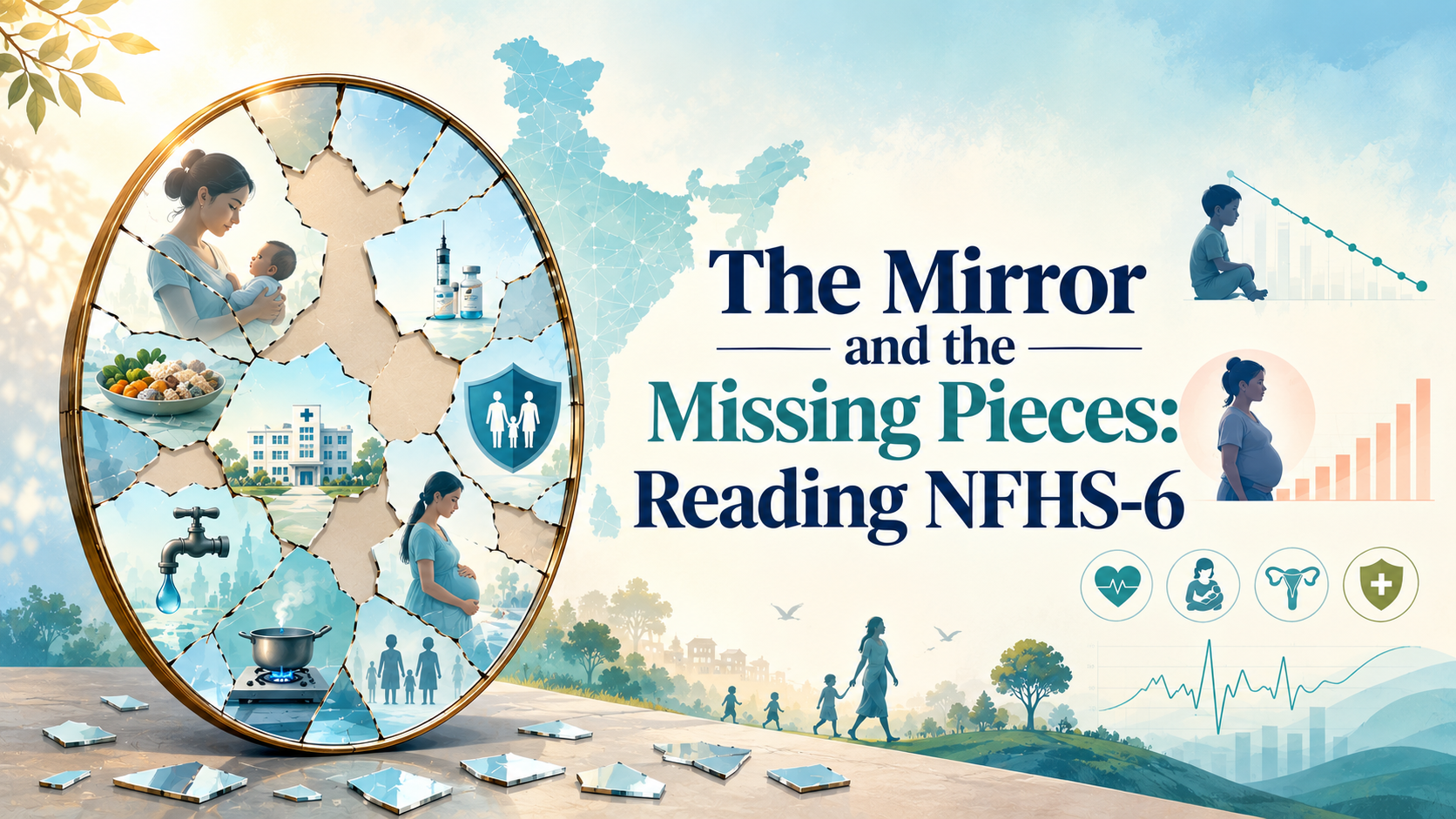
The most consequential story of NFHS-6, however, is not in the data. It is in the data that vanished. Forty-three indicators from NFHS-5 were dropped. Among them: all seven anaemia indicators, the neonatal, infant, and under-five mortality rates, sex ratio at birth, household sanitation, clean cooking fuel, cancer screening, and HIV awareness.
The official rationale is partly defensible. The anaemia estimates from NFHS-5, which showed 67% of children and 57% of women anaemic, relied on capillary blood samples, which plausibly overestimate prevalence; anaemia measurement is now being routed to ICMR's Diet and Biomarkers Survey using venous samples. Streamlining indicators to their most authoritative source is a reasonable statistical principle.
But the pattern is hard to ignore. The dropped indicators map almost perfectly onto the report cards of flagship programmes: anaemia onto Anaemia Mukt Bharat, sanitation onto Swachh Bharat, clean fuel onto Ujjwala. NFHS-5's inconvenient anaemia findings were publicly disputed by the ministry; the IIPS director who defended them was suspended in 2023; and what has been released so far is only a factsheet, not the full report. “Measure it elsewhere” also breaks the one thing NFHS uniquely offered: long, comparable trend lines that could be disaggregated by state, district, caste, and wealth quintile. A cleaner measurement in a different survey cannot answer the question policymakers actually ask: is the problem getting better or worse, and for whom?
The older, quieter limitations
Even setting aside the politics, NFHS has always demanded careful handling. It is cross-sectional, so it can describe change but not attribute it to any programme. It leans on recall and self-report for immunisation and morbidity. And its district-level estimates rest on modest samples with wide confidence intervals, yet get treated as precise scorecards, fuelling ranking exercises the data cannot honestly support.
Reading the mirror responsibly
For those of us who work with evidence, the lesson is triangulation: read NFHS alongside administrative data, SRS, and dedicated surveys; respect the uncertainty around point estimates; resist the seduction of league tables. A mirror is only useful if it is allowed to show the full face. NFHS-6 shows a healthier India in many respects, but a mirror with 43 pieces removed reflects a country that is, at best, partially visible.