

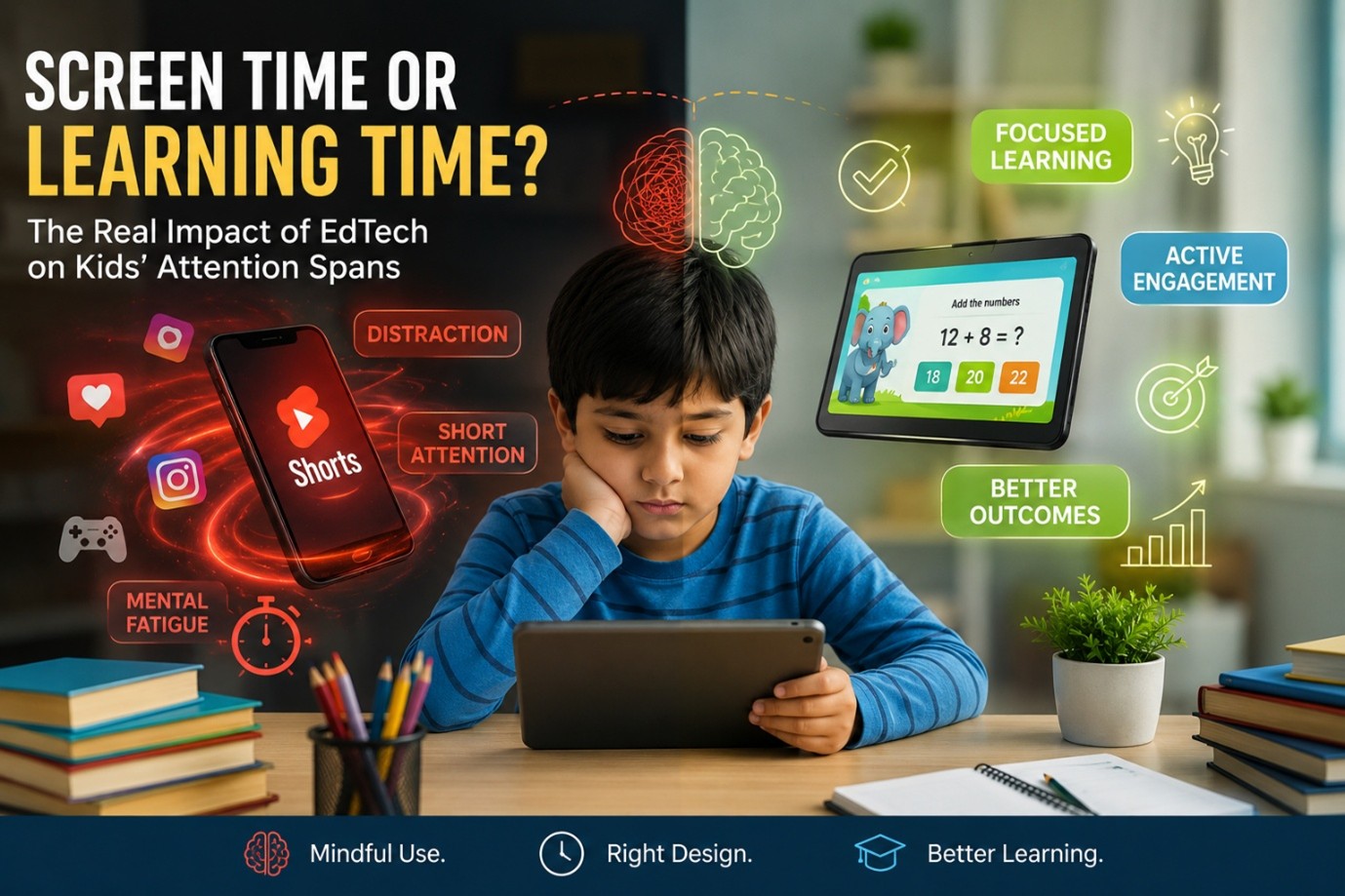
Screen Time or Learning Time? The Real Impact of EdTech on Kids' Attention Spans
Walk into almost any classroom today, and you'll see tablets on desks and interactive whiteboards up front. EdTech promised faster, more personalized learning. But parents and teachers keep asking: Is it also wrecking kids' ability to focus?
The honest answer, based on current research, is: it's complicated and messier than either the EdTech evangelists or the "screens are ruining childhood" crowd want to admit.
By the Numbers
• Screen time keeps climbing. Tweens aged 8–12 now average around 5 hours 33 minutes a day on entertainment screens, up from about 4 hours 44 minutes in 2019, per Common Sense Media tracking.
• Exposure starts early. An estimated 98% of two-year-olds watch screens on a typical day.
• Measured attention is dropping. A 2026 pediatric study spanning over 18,000 children across 11 countries found that sustained-attention scores had declined relative to prior baselines, with heavy screen users (4+ hours daily) showing a notably steeper drop in focus during testing than lighter users.
• Heavy use tracks with mental health symptoms. CDC data shows US teens with 4+ hours of daily screen time report anxiety and depressive symptoms at meaningfully higher rates than lighter users — and roughly half of US teens fall into that heavy-use bracket.
• The "8-second attention span" claim is a myth. It traces to a widely circulated 2015 report and has been debunked, yet it still gets repeated in EdTech marketing.
The Cause Isn't Just EdTech
Teachers who lived through the pandemic-to-classroom transition noticed something troubling: kids who'd spent months consuming short-form video came back struggling to sit through a normal lesson. Researchers have linked this in part to platforms like TikTok, where students became accustomed to rapid, bite-sized bursts of information, a habit that didn't vanish once school resumed. Topics on these platforms tend to capture attention sharply and lose it just as fast, training the brain toward quick hits of novelty rather than sustained engagement.
This tracks with broader data: the average student can sustain focus during direct instruction for only about 10 to 15 minutes before it drops off, and neurocognitive studies using EEG and eye-tracking show similar attentional fatigue online within the same window. Physiological engagement during a typical lecture also tends to peak in the first several minutes before declining steadily, meaning the "attention cliff" teachers describe isn't just anecdotal; it shows up in biology, too.
So yes, attention spans are shrinking, but the real culprit is the always-on digital environment kids live in, of which classroom tech is just one part. Blaming EdTech alone lets social media, smartphone habits, and home screen-time norms off the hook.
The Research Is Shakier Than You'd Think
Despite EdTech being embedded in schools for over a decade, a recent London School of Economics review found the evidence base is surprisingly thin. Studies overwhelmingly focus on narrow outcomes such as literacy and math scores, largely ignoring creativity, motivation, and well-being. Almost no research examines whether EdTech affects children differently by gender, socioeconomic background, or disability status, despite the popular belief that tech especially benefits kids with special needs.
It Can Widen Learning Gaps, Too
A long-term U.S. study tracking children from kindergarten through fifth grade found that EdTech's benefits scaled with a child's existing achievement level, a "gap-widening effect." Kids already doing well benefited more; struggling students didn't see the same lift, potentially widening the achievement gap rather than closing it.
Villain or Solution?
The same screens blamed for shrinking attention are also pitched as the fix. Interactive video formats have shown a "rebound" effect on attention compared to passive formats, suggesting design matters more than whether a screen is involved at all. The real questions are:
• Passive vs. active: are kids clicking through slides, or problem-solving and creating?
• Short bursts vs. marathon sessions: are lessons chunked to match realistic 10–15-minute attention windows?
• Purposeful vs. default: is the device used because it demonstrably helps, or just because it's there?
Schools that treat these as design questions rather than a binary tech-or-no-tech choice tend to see better outcomes. A well-built app with short, interactive checkpoints can work with a child's attention span rather than fight it. A 45-minute video lecture streamed onto the same tablet does the opposite, regardless of how "educational" the content is.
A Real-World Example: The Chimple Home Learning Programme
The Chimple Home Learning Programme offers a useful example of how EdTech can be designed and evaluated beyond simple measures of screen use. The programme aimed to strengthen foundational literacy and numeracy (FLN) among Grade 1 and 2 students through a personalised, gamified learning application, complemented by teacher-led digital assignments, parental engagement, and monitoring by education officials.
What makes the programme particularly relevant to the EdTech debate is that its evaluation did not focus only on whether children used the application. DevInsights’ evaluation examined the quality and fidelity of programme implementation, including classroom integration, student engagement, parental involvement, and system-level support. Alongside this, a Student Learning Outcomes (SLO) assessment measured students’ literacy and numeracy levels using standardised tools across sampled schools, blocks, and usage categories.
The Chimple experience reinforces an important point: effective EdTech is not simply about putting a learning application in a child's hands. It is about creating the conditions in which technology can support learning and generating evidence to understand whether it actually does.
The Takeaway
There's no clean verdict yet, despite how confidently both sides argue. What seems clear: unstructured screen time and structured EdTech aren't the same thing; design matters more than the device; equity needs far more attention if tech is widening gaps rather than closing them; and the research base is still thin enough to warrant skepticism toward both the doom narrative and the hype.
The real question isn't "screens: good or bad?" It's "which screens, used how, for how long, and for whom?"