
The Ken-Betwa Project and the Illusion of Voluntary Tribal Displacement: Development at What Cost?
An Analysis of Rights, Rehabilitation, and Reality in Chhatarpur
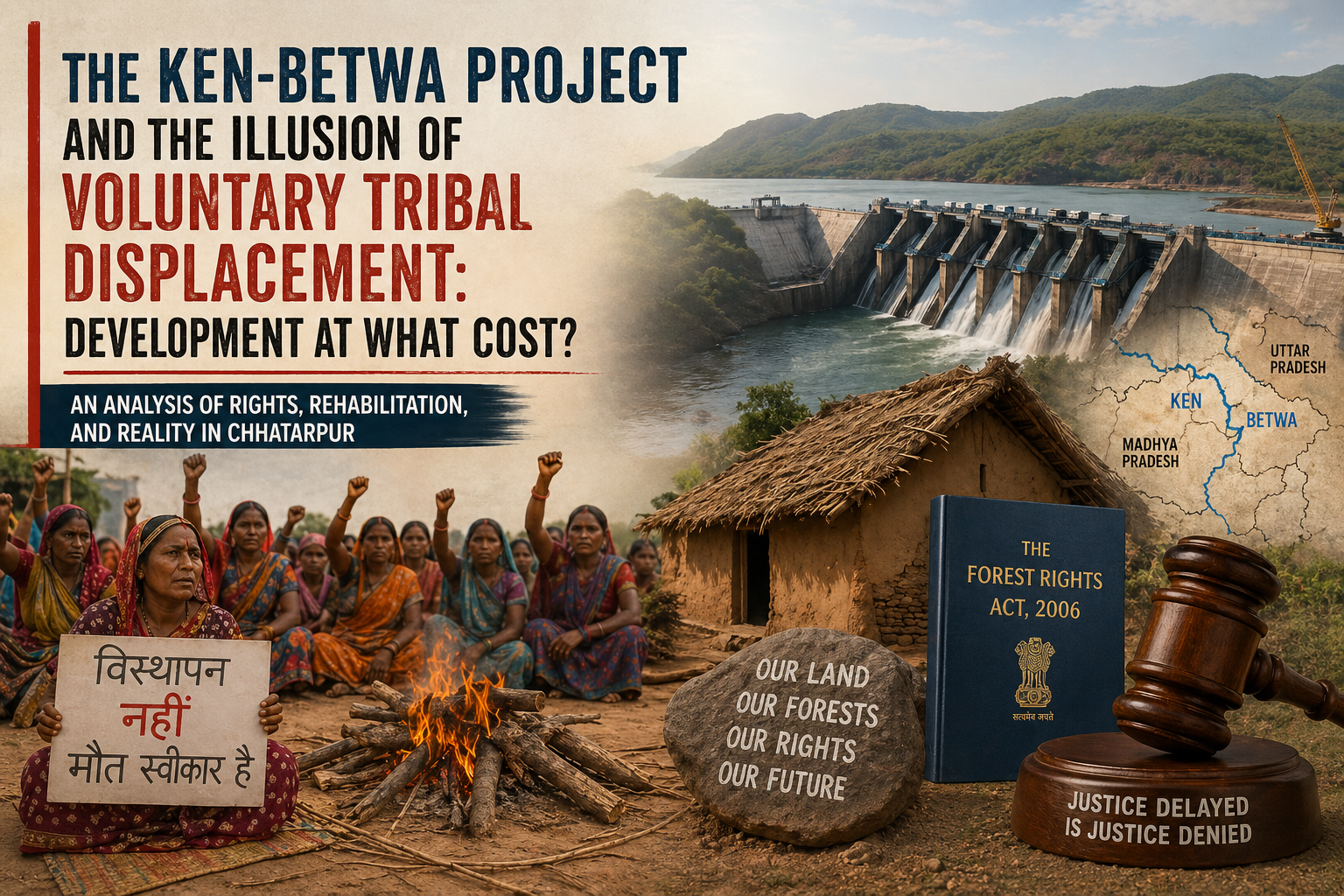
In April 2026, women from tribal villages in Chhatarpur district of Madhya Pradesh lay on symbolic funeral pyres, called the 'Chita Andolan' (pyre protest). Their message was clear that displacement under the Ken-Betwa Link Project would be equivalent to death. This demonstration raised awareness of a crisis unfolding in India's first significant river-linking project in the country's heartland, where thousands of tribal families are facing displacement even as millions are promised water security.
The ₹44,605 crore Ken-Betwa Link Project (KBLP) will divert water from the Ken River to the Betwa River. This will ensure irrigation for 10.62 lakh hectares and drinking water for 62 lakh people in water-scarce Bundelkhand. But behind this story of development lies a question, when people are offered paltry compensation, denied appropriate rehabilitation, and deprived of their forest rights, can their relocation really be "voluntary"?
The Scale of Displacement: Numbers Behind the Narrative
According to official data from the Ken Betwa Link Project Authority, the 77-meter-high Daudhan Dam will displace 5,288 families in Chhatarpur district and 1,400 families in Panna district due to land submergence and dam-related land acquisition. Most belong to the indigenous Gond and Kol tribes who have lived along forest edges for generations, depending on farming and forest produce for survival. Of the 24 villages scheduled to be displaced, 16 are being evicted for the Critical Tiger Reserve under the Wildlife Protection Act, 1972. The other eight villages will be submerged by the reservoir.
The environmental toll is equally staggering. The dam will submerge 5,578 hectares of forest land and split the Panna Tiger Reserve. Nearly 98 square kilometres of the 543-square-kilometre sanctuary under the reserve that successfully brought tigers back from the brink of local extinction in 2009.
The Compensation Catastrophe: Rs. 16 for a Home
Perhaps the most shocking aspect of the KBLP is the disparity between promised and actual compensation. Although the government declared compensation of ₹6 lakh per 30-40 years old house and ₹12.5 lakh per acre, the actual situation is very different. Tribal families were reportedly paid as little as ₹16, which is hardly enough for a meal, while another family received ₹200. Many families have received nothing at all.
According to Down To Earths investigation, the administration has treated affected families as eligible only for a cash package of ₹12.5 lakh. With this amount deposited in the bank accounts of only about 40% of families. The demand for 'land in lieu of land' and 'village in lieu of village', fundamental principles of just rehabilitation, currently seems to be being ignored.
The Forest Rights (FRA) Act: A Legal Shield Left Unimplemented
The FRA of 2006 was enacted specifically to correct historical injustices against forest-dwelling tribal communities. The Act recognises their rights to land and forest resources and, most importantly for the KBLP context, mandates specific procedures for any displacement or resettlement.
In Kamlesh Prajapati v.State of Madhya Pradesh (2024), the Madhya Pradesh High Court (MPHC) recently ruled on the Orchha Wildlife Sanctuary and addressed this question. The Court called into question the concept of 'voluntary rehabilitation' in the context of wildlife conservation. It was clear that valid consent is based on an equality relationship. The Court noted that coerced or deceitful consent is invalid, and displacement without full compliance with the Forest Rights Act is unacceptable.
Development for Whom? Analysing the Beneficiary Paradox
A closer look reveals a disturbing inequality between the costs and beneficiaries of the KBLP. The KBLP aims to benefit farmers in Uttar Pradesh by irrigating 2.51 lakh hectares across districts, including Banda, Mahoba, Jhansi, and Lalitpur. By contrast, the tribals who are being displaced in Chhatarpur and Panna districts of Madhya Pradesh are helpless and not beneficiaries. This brings into question environmental justice and inter-state fairness. Should the marginalised people in one state suffer environmental and social impacts for the irrigation benefits of farmers in another state?
Beyond the immediate human rights concerns, there are technical concerns about the project's feasibility. The water flow estimates are reportedly based on 30-40 years old, before the effects of climate change on regional water flows took hold. The government has refused to release this data, arguing that it is a security concern as an "international flow" issue (both rivers are tributaries of the Ganges, which flows into Bangladesh).
The project is being fiercely criticised by activists, including the Magsaysay Award laureate Rajendra Singh. Alternate suggestions include restoring an estimated 1 lakh natural water bodies in Bundelkhand, which could provide more water storage at lower cost and without displacing thousands of people. If there is surplus water in the Ken River, why are villagers suffering in the summer months? Sand mining has aggravated water scarcity, casting doubt on the "surplus water" claim.
The Protests: Satyagraha to 'Death'
For more than two months, communities have been engaged in campaigns through different forms of satyagraha (non-violent civil resistance), such as sit-ins, rallies, roadblocks and gheraos. On April 8, 2026, the protests escalated with the tribal women's "Chita Andolan," where they lay on symbolic funeral pyres close to the project site. A stark message was sent out that their life and dignity in the face of displacement is worse than death. This is a rare type of protest in India, but it was successful in gaining national media coverage of their struggle.
One protester told ANI News: "Our forests, land, and homes are being taken away, so we are forced to protest. It's been 10 days, today is the 11th, and no officials have come. We will not leave until our demands are met. If they ignore us, we may be pushed towards extremism. Like Durga or Kali, we too can become fierce... Our children live in fear, but the government doesn't care what happens inside our homes."
What 'Voluntary' Really Means
International principles on indigenous rights and development-related displacement offer useful guidelines for judging the KBLP. The Free, Prior and Informed Consent (FPIC) principle is increasingly recognised as a fundamental right of indigenous peoples, as enshrined in the UN Declaration on the Rights of Indigenous Peoples.
· Free means consent is not coerced, intimidated or manipulated.
· Prior means consent is sought early enough to authorisation or implementation, allowing for meaningful consultation.
· Informed means information supplied in relation to the nature, size, pace, reversibility, and extent of the project; reason or purpose; duration; location; preliminary assessment of the economic, social, cultural and environmental impact; persons likely to be involved; and processes that may be followed in carrying out the project.
The KBLP's "voluntary rehabilitation" is well short of this mark.
Conclusion: Rethinking Development Justice
The KBLP is a turning point in India's development. Will we build more megaprojects at the expense of the vulnerable communities and in favour of the rest, or can we imagine a different form of development which is inclusive and just?
The tribal communities of Chhatarpur are not opposed to development per se. They are demanding what every citizen deserves: dignity, justice, and the right to determine their own futures.
Some immediate reforms that may be considered:
· Consultation with the local community through Gram Sabhas with free, prior and informed consent.
· Open data sharing of hydrologic data and independent feasibility studies, including current climate change data.
· True "land for land" and "village for village" rehabilitation rather than cash payments.
· Exploration of other methods, such as the revival of traditional water bodies, is recommended by water experts.
Chhatarpur's tribal people are not against development. They are asserting their right to dignity, justice and self-determination, which they share with all of us. Their protest challenges us to ask whether the water security of millions is truly incompatible with the dignity and rights of thousands.
As India pushes forward with ambitious infrastructure projects, the Ken-Betwa will be a warning or a model for how to deal with marginalised communities. The choice, and the responsibility, lies with us.