
From Law to Reality: Are Child Protection Policies Really Working?
1. Introduction: The Confidence of Law, The Complexity of Reality
In the past twenty years, India has done well for itself in developing its legal framework around the protection of children from abuse, exploitation, and neglect. It has a comprehensive and organized approach on paper.
According to figures compiled by the National Crime Records Bureau (NCRB), more than 1.6 lakh cases of crimes against children have been reported in 2022 in India. Although these figures indicate an increase in reporting, there is no disagreement among experts regarding the fact that the actual figures are significantly higher than the reported numbers.
Nevertheless, the findings of fieldwork, assessments of program efficacy, and analysis of official figures indicate that vulnerabilities persist. Abuse cases continue to go unreported, response mechanisms are not uniform, and the outcomes are extremely disparate depending on geographical location.
The most fundamental problem posed here, therefore, is as follows: How come a proper protection regime cannot guarantee consistent protection if the system exists in place?
The answer requires an understanding of both what policies claim and what reality looks like.
A Strong Framework-But Systems Are Only as Effective as Their Reach
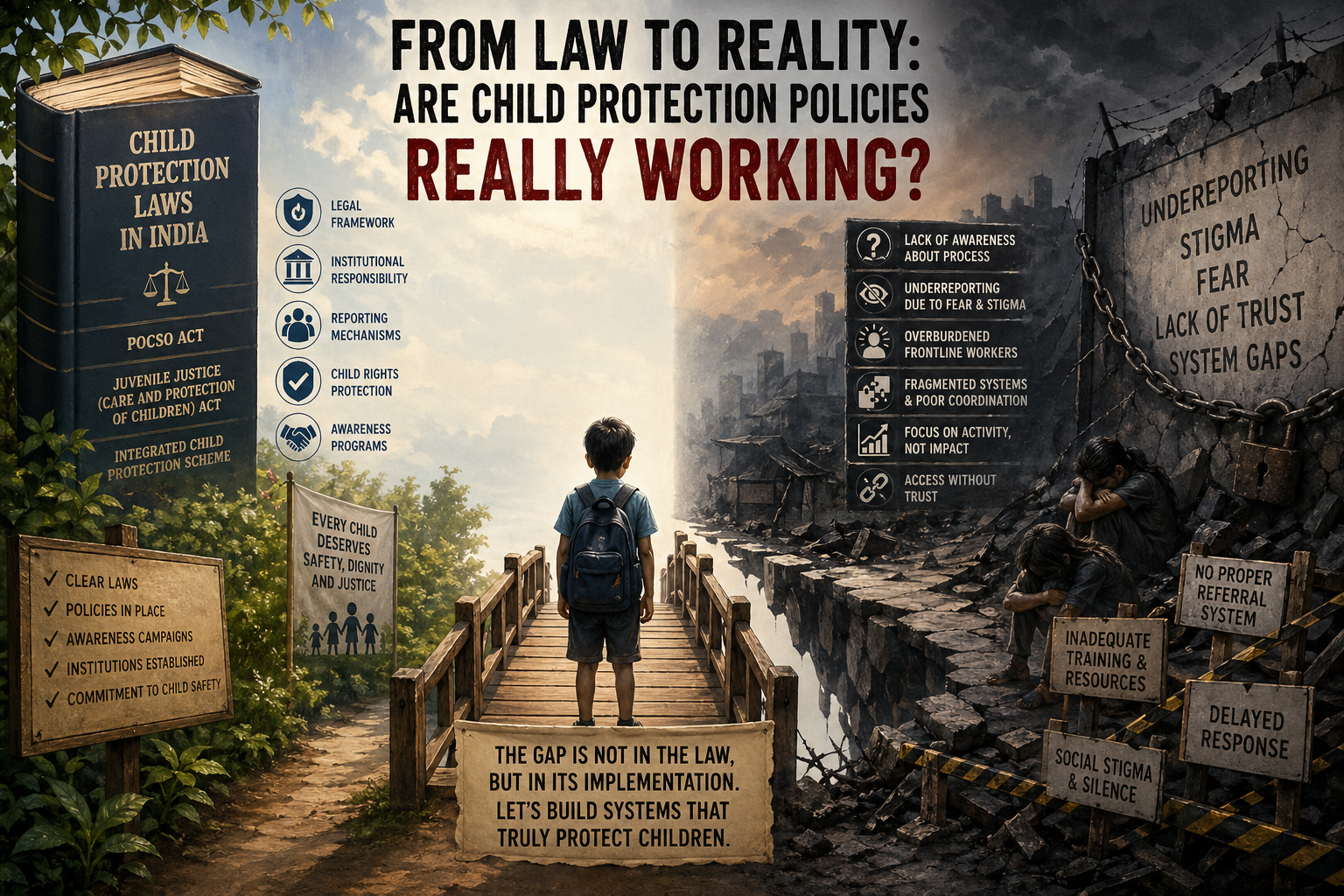
The Protection of Children from Sexual Offences Act and the Juvenile Justice (Care and Protectionof Children) Act are two of the most important laws that protect children in India. The Integrated Child Protection Scheme helps make sure that these laws are followed.
These frameworks establish:
· Clear legal definitions
· Institutional responsibilities
· Reporting and response mechanisms
However, policy strength does not automatically translate into system effectiveness. The transition from design to delivery is where most challenges emerge.
2. Where the System Slows Down: Insights from the Ground
1. Awareness Does Not Equal Access
A recurrent theme throughout various assessments carried out at different fields is an inconsistent understanding of child protection laws.
One such study, conducted by child rights organizations, revealed that although over 60% of caregivers knew of child protection laws, only less than 30% of them were aware of the process of reporting.
• Caregivers may be aware of the laws but not clear about the process of reporting
• The children may lack the space to report any incidents of abuse
The culture within the community may prevent seeking help from outside. Access is still based on trust, even in places where awareness campaigns have been held. Families might not want to use formal systems because they are afraid of what will happen to them socially or because they don't trust the authorities. In practice, this creates a gap where knowledge exists, but usability does not.
2. Underreporting Is Not an Exception - It Is Structural
From a research perspective, under reporting is not a limitation of the system it is a defining feature of it.
Cases frequently go unreported due to:
· Fear of retaliation, especially in close-knit communities
· Economic dependence on perpetrators within households
· Concerns around family honour and social stigma
However, data from the National Crime Records Bureau can provide useful information on reported cases, which should be treated with caution because they indicate system visibility rather than actual incidences.
This has direct implications for policy:
· Risk levels may be underestimated
· Resource allocation may not match actual need
· Preventive strategies may remain underdeveloped
In effect, decision-making is often based on partial data, which limits system responsiveness.
3. Frontline Systems Carry the Weight of Implementation
Operational efforts for child protection hinge largely upon frontline agencies:
• Child Welfare Committees
• District Child Protection Units
• Social workers and police officers
Unfortunately, experiences from program evaluations suggest common difficulties:
• Case volumes that exceed realistic limits
• Insufficient opportunities for specialized child-focused training
• Admin and reporting pressures leaving little time for dealing with cases
Consequently, the approaches employed can be characterized as being:
• Procedure-based and not holistic
• Reactive and not preventative
• Timed and not continuous
4. Fragmentation Limits Early Intervention
Child protection overlaps with various fields including education, health, and community networks, each contributing towards early detection of the problem.
Nonetheless, there is limited collaboration among different sectors within the field of child protection.
For instance:
• The educator may notice changes in behaviour in the victim but has no proper referral procedure.
• The health care practitioners may know that the case involves physical, sexual, or psychological abuse but do not report the issue to the authorities.
In this situation, the system does not act fast enough to stop the worsening of the problem.
The lack of coordination makes the system less effective in preventing an escalating situation.
5. Measuring Activity vs Measuring Impact
One of the biggest problems with child protection systems is that they focus on outputs instead of outcomes.
Most monitoring frameworks keep an eye on:
• Number of cases that have been reported
• Number of sessions held to raise awareness
• Number of organizations set up
Even though these are important signs, they don't answer important questions:
• Are kids safer?
• Has the quality of the response gotten better?
• Do the results of rehabilitation last over time?
This makes it look like systems work well from an administrative point of view, but the irreal-world effectiveness is still not being fully assessed.
The Human Dimension: What Data Alone Cannot Capture
While quantitative data provides structure, it does not capture the real-life experiences of children within protective processes. Field accounts commonly reveal:
• The anxiety and reluctance prior to reporting sexual assault
• The psychological strain involved in undergoing the judicial process
• The requirement for psychosocial support after immediate care
UNICEF, among others, has underscored the need for viewing child protection as an ecosystem, rather than simply legislation.
There in lies the fundamental issue while protective systems can address cases, they often fail to respond to experience.
3. What Needs to Change: Moving Toward System Effectiveness
Bridging the gap between law and reality requires a shift from system presence to system performance.
1) From Awareness to Trust
Efforts must focus on building trust-based ecosystems, where reporting is safe, supported, and stigma-free.
2) From Coverage to Quality
Expanding reach must be complemented by improving the depth and quality of engagement at the frontline level.
3) From Fragmentation to Convergence
Strengthening coordination between education, health, and protection systems can enable earlier and more effective interventions.
4) From Data Collection to Data Use
Data should inform adaptive decision-making identifying gaps, refining strategies, and improving targeting.
5) From Legal Compliance to Child-Centric Practice
Systems must prioritize the emotional, psychological, and social well-being of children—not just procedural correctness.
4. Conclusion: Rethinking What “Working” Means
The Indian child protection laws are not weak; there is a clear institutional commitment to child safety. However, the mere existence of laws does not mean that effectiveness can be established.
It must be assessedvia:
• Easeof system utilization
• Quality of the response
• Improved health among children
Scholars should not only document systems but also critically assess their effectiveness in achieving desired objectives. This is because the true measure of the effectiveness of a child protection system is how well children remain protected, dignified, and healthy in their daily lives, not in policies or statistics.
Are we increasing protections when designing them, or are we merely documenting them better when children have to manoeuvre risks to stay protected?