
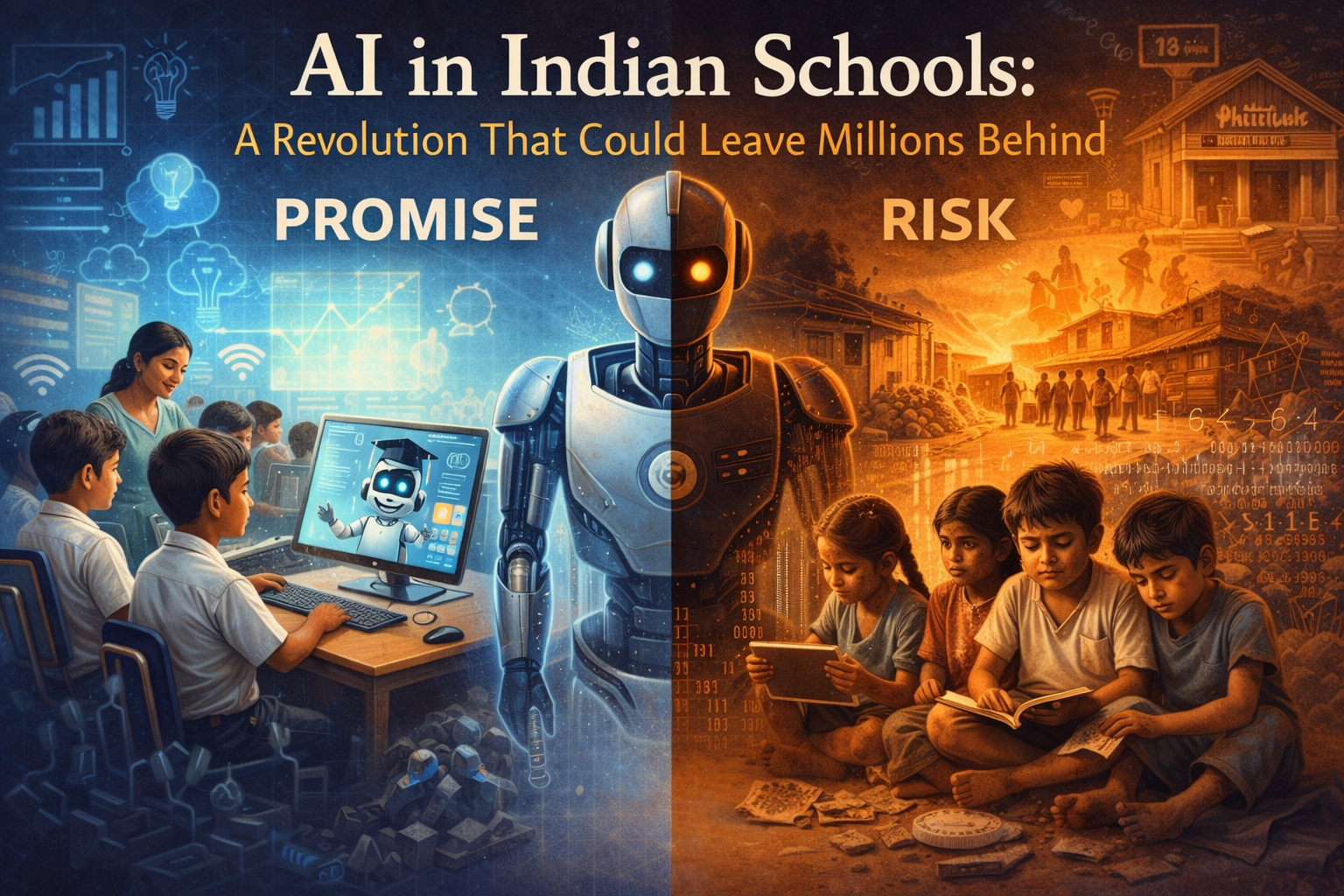
AI in Indian Schools: A Revolution That Could Leave Millions Behind
Artificial Intelligence will become a school subject starting the academic year 2026-27 and will be taught to students in Class 3 of India. In a nation in which 47.44 million 6-17-year-old children are not enrolled in school and just 57.2% of schools have computers and 53.9% access the internet (UDISE+, 2023-24), that declaration is a promise and invitation equally. The AIs-in-education market is growing rapidly, with a projected value of 20 billion in 2027, and India is among the fastest-rising voices in this field.
Market size and meaningful impact are quite different things, particularly when you are targeting the children of daily-wage workers, tribal groups and first-generation students. Whether AI will change education is not the question that the social sector needs to ask. It will. The question is: transform it for whom?
The Learning Crisis in India: The Stable AI will have to face
We need to sit by the numbers before we celebrate the algorithm. The Azim Premji Foundation (2021) reports that nearly 60% of children lacked access to online learning during the pandemic. In other states such as Bihar and West Bengal, which are home to some of the most disadvantaged communities in India, the use of computers and the internet in the schools is less than 25%. And 26.8% of the Indian youth aged 6-14 have basic internet browsing skills, and such states as Meghalaya and Tripura have even lower (below 10%) numbers. It is not a platform upon which you just unleash AI and miracles will occur. It is a structural crisis that cannot be solved by AI and might become worse in case of ineffective implementation.
The Pledge: One-on-One Learning on the Scale India Requires
With that said, the potential of AI in a country of 250 million schoolchildren in 1.5 million learning institutions is truly great. Classrooms are overcrowded, multilingual, and highly unequal in teacher-to-student ratios. Adaptive AI-based learning platforms that scale difficulty and pace in real time based on individual students' performance provide an opportunity most Indian government schools have never had: truly personalised learning. On the global scale, AI can help teachers reallocate 20-30% of their time to direct student-facing activities (McKinsey, 2025), and AI-driven adaptive programs such as Knewton have been shown to increase exam scores by 62%. To teachers already overwhelmed, AI promises to take some of the administrative load off lesson planning, grading and tracking progress, and allow time to do what computers are incapable of doing: human contact and guidance. 60% of teachers used AI tools in 2024-25, with weekly users saving an average of 5.9 hours, which can be redirected toward students. The approach of engaging students between 8 and 12 years old by incorporating AI literacy with social-emotional learning in virtual labs, called YUVAi by India itself, is an indication of what can be achieved when design is built with inclusion as the objective, and not an exception.
The Danger: AI as a Multiplier of Pre-Existing Inequality
However, the social sector has seen too many so-called revolutionary education technologies come in with much attention and further divide the gap. AI is at risk of doing so, faster and more massive. The digital divide is not only about connectivity. The Internet is also unreliable and costly, even where it is available. Scheduled Caste, Scheduled Tribe, and OBC students have a disproportionately low number of devices, constant connectivity, and digital literacy levels that AI tools presuppose. In the Indian context, algorithmic bias is not a possibility. The artificial intelligence systems trained on the basis of predominantly English-speaking, urban and upper-caste knowledge will just not be fair to the students with the non-dominant linguistic and socioeconomic background. There are more than 19,500 languages and dialects in India, but most of the products in edtech AI operate in a few. AI-powered grading systems are often biased by the training data, which makes them unfair to most students who do not conform to the ideal learner the algorithm was trained to identify. The data of children is under threat and India has already had an experience of this. In 2023, Human Rights Watch exposed that over a year, the Indian government itself in its own Diksha app had revealed personal information of close to 600,000 students and more than a million teachers onto the open internet. In a survey by the HRW around the world, 89 out of 163 education apps gathered information on children in a manner that endangered or infringed upon their rights in 2022. The 2023 UNESCO Global Education monitor (GEM) Report has reported that of the 160 countries surveyed, only 16% have national legislation that expressly guarantees data privacy in education. The Digital Personal Data Protection Act, 2023, in India is a move in the right direction, although the application in the educational sector is still in its infancy.
What Needs to Happen
To ensure inclusive growth, the country must move beyond deploying AI to actively democratise AI in education.
• Infrastructure before algorithms - Advocating for device access, reliable connectivity, and electricity in government schools, particularly in aspirational districts, must precede AI deployment, not follow it. Odisha's focus on localised language content and Punjab's targeted infrastructure investment are state-level models worth scaling.
• Vernacular-first AI design - Organisations working with grassroots communities must demand that AI tools be built in and for local languages. Co-design with communities is non-negotiable.
• Data rights as child rights - Push for strong regulatory safeguards on student data, and build awareness among parents and school administrators, is an urgent civil society work. India must urgently move from legislation to enforcement.
• Teacher readiness as a prerequisite - Funders and program designers must invest in teacher capacity alongside platform deployment. AI without trained teachers is technology theatre.
In conclusion, unless equity-based interventions are prioritised, India will enter a future in which AI will be as much an advantage to those already privileged as it is a disadvantage to children in rural Bihar, in tribal hamlets of Jharkhand, and in the slums of Mumbai, who will still lag behind. The NEP 2020 of India is a strong voice of equality and inclusive education. AI should be used to support such a vision, and not to counter it. The technology is ready. The question is whether the will, the policy, and the civil society pressure are ready too.
References:
https://educationforallinindia.com/out-of-school-children-oosc-in-the-light-of-udiseplus-2023-24-data-and-its-implications-on-nep-2020-goals/
https://www.education.gov.in/sites/upload_files/mhrd/files/statistics-new/udise_report_existing_23_24.pdf
https://azimpremjiuniversity.edu.in/publications/2021/report/learning-loss-during-pandemic
http://publications.azimpremjifoundation.org/2490/1/Loss_of_Learning_during_the_Pandemic.pdf
ttps://www.deccanherald.com/amp/story/opinion/the-risk-of-unequal-ai-education-in-indias-schools-3804248
https://www.mckinsey.com/~/media/McKinsey/Industries/Social%20Sector/Our%20Insights/How%20artificial%20intelligence%20will%20impact%20K%2012%20teachers/How-artificial-intelligence-will-impact-K-12-teachers.pdf
https://news.gallup.com/poll/691967/three-teachers-weekly-saving-six-weeks-year.aspx
https://www.hrw.org/news/2023/01/27/indian-government-app-exposed-childrens-personal-data
https://gem-report-2023.unesco.org/