

Corporate Social Responsibility (CSR) in the Education Domain: From Compliance to Nation-Building
CorporateSocial Responsibility (CSR) in the Education Domain: From Compliance toNation-Building
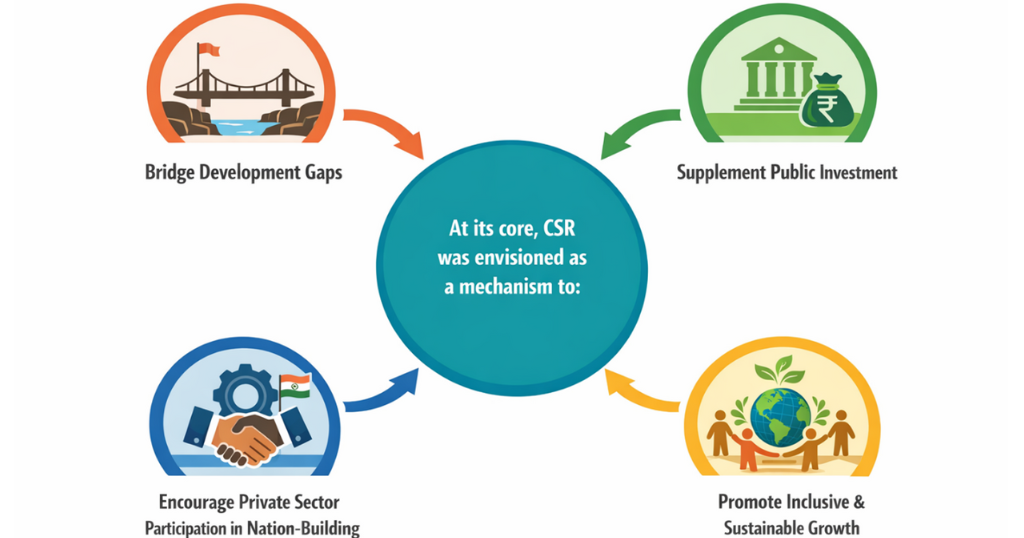
CSRis a Company’s commitment to operate in an economically, socially, andenvironmentally sustainable manner, while recognising the interests of itsstakeholders. The CSR policy aims to ensure that the Company becomes a sociallyresponsible corporate entity committed to improving the quality of life ofsociety at large. CSR spending in Indiawas a breakthrough as India became the first country in the world to compelcompanies to spend on corporate social responsibility, and no longer adiscretionary giving by companies to the needy
CSRin India is not only a voluntary process of philanthropy, but it is also astatutory duty rooted in public policy. Section 135 of the Companies Act,2013, formed the legal basis of CSR as it requires eligible companies touse 2 % of their average net profits of the three previous years onsocially beneficial activities.
InSchedule VII, the Act clearly provides priority areas to CSRspending, such as education, special education, vocational skills, health,livelihoods, environment and social equity.
Thisblog sheds light on the role of CSR in the future of the Educationsphere in India, as CSR has come to be recognised as not a mere tokengesture, like donating infrastructure or hosting special events, but a majornon-government source of financing in the social sector, especially education.
Educationin India: Scale, Aspirations, and Structural Gaps
Asper the UDISE+ report 2022-2023, the education system of India is one of the largestin the world, covering more than 260 million students in schools and highereducation centres. India has a target to achieve universal school enrolment by2030, as outlined in the National Education Policy (NEP) 2020. Thepolicy aims to provide high-quality education to all students, ensuring accessto quality education for every child. Butquality, equity and learning outcomes continue to be challenges that need to be addressed.
NEP2020 recognises these issues and demands a comprehensive change, which prioritises:
· FoundationalLiteracy and Numeracy (FLN)
· Hands-onlearning experience
· Careerexposure
· Theuse of technologies and
· Inclusion.
Nevertheless,the realisation of these high-level targets cannot be attained solely throughthe public budgets. CSR has come intothis scene to a greater extent, not as a replacement of the state, but as astrategic ally. CSR has enabled companies to effect of tangibly influenceclassrooms, teachers, students, and communities. CSR has enabled companies to:
· Investin human capital
· Increasetechnology in the learning process
· Addressregional disparities and social inequities
· Encouragenew ideas and pilots that can be expanded by governments
HowMuch Is Being Spent?
InIndia, education has always been the biggest beneficiary of CSR funds. Inrecent years, CSR spending has increased substantially. CSRexpenditure has gone rampant to counter learning loss and digital exclusion. Accordingto the Ministry of Corporate Affairs (MCA):
· Educationrepresented approximately 32-35% of the overall CSR expenditures.
· CSRFY 2022-23 expenditure in education is higher than 26,000 crores.
· Inthe CSRs, an amount of over 1.4 lakh crore has been spent since 2014, witheducation being the major sector spending.
Sincethe inception of the CSR, it has walked a long way on the path of socialdevelopment. It has increasingly evolved to be no longer visible as projectsbut impact-driven interventions. Let's see this journey through two phases: EarlyPhase (2014-2017) and Maturing Phase (2018-Present)
Alignmentwith Government Programs and Policies
CSRis not working in silos for social development. It has started contributing tothe education sector in alignment with the government policies and initiatives.Some of the key interventions are cited below:
Ø Samagra Shiksha Scheme is for school education coveringthe entire gamut from pre-school to class XII. In alignment with the scheme,CSR programs assist in school infrastructures,teacher training, remedial education, libraries, and digital learning inaccordance with state school education strategies.
Ø National Education Policy (NEP)2020 aims totransform India's education system by promoting holistic, inclusive, andmultidisciplinary learning, making it more accessible and aligned with theneeds of the 21st century. CSR initiatives also invested in Experientiallearning, vocational exposure, STEM lab, coding, and career guidance to directlycontribute to NEP goals.
Ø Under NEP, Nipun Bharat Mission aims to ensure that every child in India achieves foundational literacy and numeracy by the end of Grade 3, with a target completion date of 2026-27.CSR initiatives also invested in FLN content, community reading and teachercapacity-building.
Ø The Aspirational District Programme aims to transform 112underdeveloped districts through targeted socio-economic initiatives andcollaborative efforts. Some corporates are currently setting up CSR budgets indistricts with low education and human development rates. This helps to upliftthe developmental indicators in the aspirational districts.
FaultLines
Corporationsthrough CSR have contributed immensely to the education domain to strengthenalmost all of its components. Nevertheless, there are still a number ofchallenges:
Ø Inequal geographic Distribution: The CSR funds are concentrated inthe industrialised states. CSR inflows have been greatest in states such asMaharashtra, Karnataka, Gujarat, Odisha and Tamil Nadu. Remote, tribal,conflict-stricken areas are underfunded.
Ø Short-Term Projectisation: Many initiatives last 1-3 years, alongwith poor exit strategies and ownership.
Ø Measurement Gaps: Excess reporting of inputs(schools covered, devices distributed) reduced reporting of learning outcomesand long-term effects.
Ø EdTech Hype Pedagogy: Lack of training of teachers andinstructors poses a threat of increasing disparities in learning.
BreakingBarriers
Theneed of the hour is to enhance CSP projects to advance change in education.Key Shifts Required are:
Projectsto partnerships: Increasingthe partnerships more than 2 to 4 years with schools, districts andstates.
Targetvulnerable geographies:unreached geographies and societies should be the target for new CSRinitiatives. States like Chhattisgarh, the North East region, and communitieswith lower socio-economic indicators should be the ideal target ofinterventions.
Conclusion: Provided that the boardrooms ofIndia take their 2% CSR requirement in line with the long-term educationobjectives of India, CSR will not simply finance the initiatives it is going todetermine the future of the children, workforce, and democracy of the childrenof India. It not only contributes to achieving Sustainable Development Goal 4Quality Education, but also contributes towards the journey of Viksit Bharat.


.jpeg)


