
Are Digital Devices Transforming Education for All?
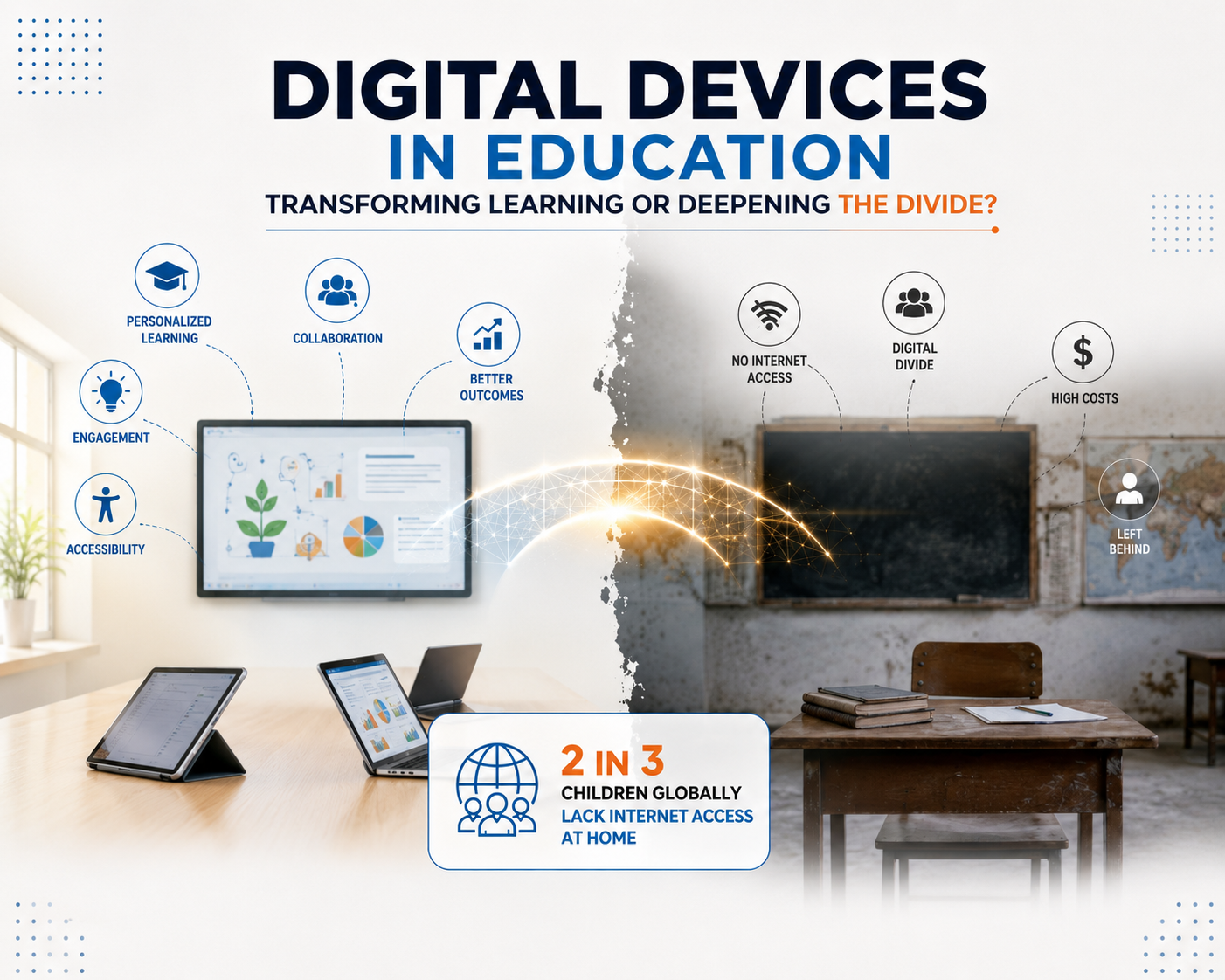
Digital devices have the power to transform teaching and learning, offering new methods of instruction, assessment, and engagement. However, realizing their potential requires careful attention to infrastructure, policy, teacher training, and equity. We review evidence on device access and learning outcomes: for example, roughly half of lower-secondary schools worldwide now have internet for teaching, yet an estimated two-thirds of children lack home internet (roughly 1.3 billion globally). This divide is stark across income and regions (e.g. <6% of youth in low-income countries have home internet vs 87% in rich countries). Research advocates that digital tools can improve personalized learning through engagement, while the benefits depend on the context of usage. Key factors,which influence role of digital tool in education, include supportive policy and infrastructure, teacher preparation, inclusive practices, and robust monitoring. DevInsights, a research and evaluation firm and can help design assessment frameworks, which could aid in refining device-based initiatives. Below is the discussion on pedagogical roles of infrastructure, devices, teacher capacity, equity considerations and policy issues, monitoring, and implementation steps.
Pedagogical Roles of Devices
These digital devices can provide instruction using multimedia forms (video, simulation) and interactive platforms. In this way, they serve as an instructional medium that allows students to grasp the subject matter and get instant feedback regarding their assignments. For instance, educational apps accessible through tablets or smartphones can take over the place of traditional paper-based assessments and provide more fun and easily comprehensible content. They help provide assessments in the form of fun activities such as quizzes and assignments, as well as provide instant tracking of progress through learning analytics to the teacher and the learner.
Devices also foster student engagement and collaboration. Interactive simulations, virtual labs or math games can capture interest. One review notes that digital learning tools “fill [the classroom] void” left by traditional methods by efficiently reengaging students. Social learning can also be enabled (discussion forums, group projects). Importantly, devices can give quieter students a voice (e.g. viachat or polls) and support differentiated instruction to meet diverse needs. But technology isn't a cure-all; if screens aren't utilised properly, they can be distracting. Research stresses that device use must be pedagogically driven. As UNESCO notes, effective technology use depends on meeting system conditions like access, governance and teacher preparation.
Infrastructure and Policy Constraints
Strong infrastructure is a prerequisite. This includes device provisioning, reliable electricity, and internet connectivity. Despite recent gains, gaps persist. For instance, only about 50% of lower-secondary schools worldwide have internet connectivity for pedagogical use (2022). In low-income regions, school and home connectivity is far lower. UNESCO reported during COVID-19 that half of the world’s learners lacked a home computer, and 43% had no home internet. Without connectivity and devices, digital learning can’t reach many students.
Policy decisions also shape outcomes. This highlights that interventions should focus on hardware installation and maintenance, and while providing appropriate content. UNESCO’s GEM report highlights that SDG4 achievements require addressing access to technology, effective governance/regulation, and teacher training. For example, in many countries, policies may mandate device provision (like one-to-one laptop programs) or curriculum changes (digital literacy standards). Yet policies often lag technology adoption, especially in resource- constraint settings. Moreover, decision-makers sometimes weigh cost–benefit trade-offs like overspending on tech in places which lack in basics (books, trained teachers), this worsen inequality.
Costs and Sustainability: Providing devices (especially one-to-one) is expensive. Total cost of ownership includes purchase, repairs, and connectivity fees. An AIR report notes that some districts, facing post-pandemic budget cuts, are reconsidering one-to-one models due to these costs. Policies must plan for long-term funding and consider lower-cost models.
Teacher Capacity and Professional Development
Even with devices in place, teacher readiness is critical. Many educators lack training on how to integrate technology effectively. UNESCO reported that in Sub-Saharan Africa, only 64% of primary and 50% of secondary teachers had any minimum training, often excluding ICT skills. Without support, teachers may revert to lecture or (worse) give unstructured screen time.
Professional development should therefore cover both technical skills and pedagogical methods. For example, training might show how to use tablets for group work, or how to interpret data from e-assessments. Other ways to spread effective practice include peer mentoring and communities of practice. This can be followed by combining hardware roll-out with ongoing teacher coaching and easy-to-use resources, where device programs have succeeded.
DevInsights and similar agencies canassist here: by conducting assessment on training needs assessments or piloting PD models, this will help in ensuring that teachers are confident and competent. In practice, they could evaluate how well teachers use new devicesand recommend tailored training.
Equity and the Digital Divide
Equity is a central concern. Technology can amplify inequalities if not carefully managed. Wealthier students typically have better access. For instance, UNICEF/ITU found only 16%of children from the poorest households have home internet, versus 58% from the richest. Regionally, the gulf is stark: in West/Central Africa about 95% of school-age children lack home internet (vs 67% global). Rural and marginalized groups often fall furthest behind. Girls may have less device access or online time than boys in some cultures.
Digital divide has remained one of the pressing issues in India too. According to the Oxfam India, Inequality Report (2022), whereas about 67% of urban populations are internet users, the number stands at just 31% in rural India. Furthermore, the difference between rural and urban populations was reflected even in education, where only 4% rural population had access to computer connectivity, as opposed to 21% urban. Moreover, the rate of digital literacy has remained relatively lower in rural India (25%) as compared to urban India (61%).
The onset of the coronavirus pandemic brought to light these disparities once more. As education moved online, many low-income families and those from remote locations could not afford smart phones, computers, or even internet connectivity, and there fore could not regularly attend classes. This situation was exacerbated for students who resided in tribal and hilly regions.
The programs must concentrate on the disadvantaged learners in order to promote inclusion. This can be achieved by creating digital learning centers in the communities, creating computer labs in schools, supplying the learners with low-cost devices, and creating learning materials in local languages. Already, in India, efforts have been made by the government to implement such measures by offering digital learning materials in various languages via platforms like DIKSHA and PM eVIDYA. In case of poor internet connectivity in some regions, learning centers, radio/television teaching, or pre-loaded tablets can come in handy.
In addition, the policies need to cater for learners with special needs. The devices and programs must be able to offer learners with physical challenges facilities such as text-to-speech function, screen readers, captions, and big button designs. Also, it is imperative that no learner should be disadvantaged with regards to their marks or attendance due to lack of proper access to digital platforms. Digital equity will been sured if all learners can access technology-enhanced learning equally irrespective of economic, gender, geographical, linguistic, or special-needs factors.
Monitoring and Evaluation
Monitoring and evaluation are crucial throughout implementation in order to evaluate effectiveness and equity. Some of the key variables could be device usage, completion of online tasks, learning outcome improvement (such as scores on exams), and satisfaction levels amongst teachers and students. Device data (login numbers, quiz scores, etc.) could be fed into dashboard displays. The caution should be used when interpreting data (for example, a login does not equal learning).
Institution such as DevInsights could play a significant role in this process. Possessing extensive experience in evaluations, it would be able to conduct high-quality research or establish a real-time feedback system. As an example, DevInsights conducted evaluation of programs focusing on foundational learning and digital literacy. In that manner, it could employ similar approach for evaluating device program, including its usage rate and performance indicators.
Key Statistics
· Digital divides: Internationally, fewer than one-third of kids have internet at home; nearly 90% do not have access in Sub-Saharan Africa and South Asia.
· Connections in schools: Almost 40% of global primary schools have no internet. Among those that have connections, device availability is highly inconsistent.
· Consequences for education: Studies reveal mixed evidence. In meta-analysis, there are certain positive findings (such as digital games help improve literacy; programming helps in solving problems), but just having access to technology does not guarantee educational benefits.
· Education gap: There is a huge disparity between rich and poor kids when it comes toaccess: 58% vs 16%. It is influenced by wealth, geography, and gender.
Recommendations
· Plug infrastructure gaps: Pay attention to connectivity investment in schools aswell as their vicinity (internet, electricity). Cooperation with similar projects like that of UNICEF/ITU could be considered in order to guarantee equity of internet access.
· Teacher Trainings: Ensure proper training for teachers on how to use technology inteaching. Include ICT literacy in essential criteria for teacher certification and plan regular teacher training sessions.
· Equal opportunity: Apply different models so that everyone gets equal access. Lend/rent devices to learners who don’t have their own devices.
· Monitoring and evaluation: Set up monitoring systems (data collection from devices, participation statistics) as well as carry out impact assessments. Try to get professional help to make M&E better.
· Quality of education: Put students’ learning before everything else. Choose appropriate apps and materials based on learning objectives. Determine acceptable amount ofdevice use time.
Digital devices are very powerful tools for education as long as they are used properly. With thoughtful application, inclusion of digital devices ineducation will greatly benefit students’ progress.
References
1. Technologyin education - 2023 GEM Report (https://gem-report-2023.unesco.org/technology-in-education/)
2. https://www.unicef.org/press-releases/two-thirds-worlds-school-age-children-have-no-internet-access-home-new-unicef-itu
3. Howmany children and young people have internet access at home? - UNICEF DATA (https://data.unicef.org/resources/children-and-young-people-internet-access-at-home-during-covid19/)
4. Understandingthe role of digital technologies in education: A review – ScienceDirect (https://www.sciencedirect.com/science/article/pii/S2666412722000137)
5. Startlingdigital divides in distance learning emerge | UNESCO (https://www.unesco.org/en/articles/startling-digital-divides-distance-learning-emerge)
6. AIand technologies in education | UNESCO (https://www.unesco.org/en/digital-education)