

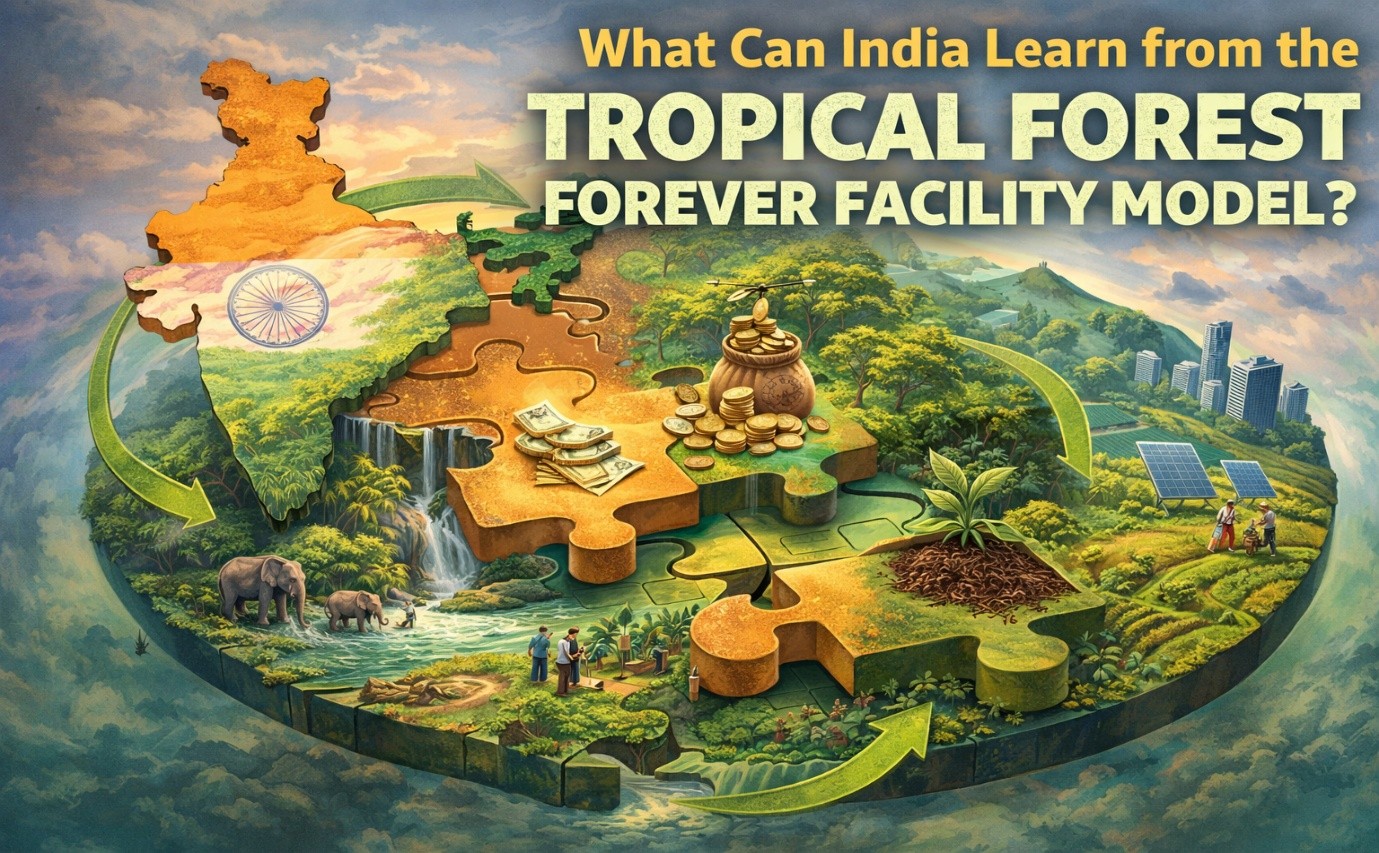
What can India Learn From the Tropical Forest Forever Facility Model?
The Tropical Forest Forever Facility (TFFF), launched at COP30 in 2025 with Brazil as the COP President, marks a revolutionary shift in the way tropical forest conservation is funded with long-term performance-based financing in over 70 countries covering more than 1 billion hectares of moist broad leaf forests worldwide. Backed by initial pledges of more than $5.5 billion from countries such as Norway, the UK, and Indonesia, TFFF is set to raise up to $100 billion in blended public and private sector funding with diversified returns of $3-$4 billion annually from countries that achieve deforestation rates of less than 0.5% annually. This marks a significant shift from short-term funding like the REDD+ system towards long-term funding with payments made against actual outcomes using satellite monitoring techniques such as canopy cover of 20-30%and the absence of plantations with at least 20% of the funds directly allocated to IPs/LCs at the grassroots level.
India, with 25.17% forest and tree cover spanning 807,000 square kilometres, is struggling with tropical forest problems that make the framework established by TFFF highly applicable, despite being an observer to this initiative due to differences in forest cover definitions, with 10% canopy cover in India as opposed to more stringent criteria by TFFF. In 2024 alone, India has lost 18,200 hectares of primary humid forests, leading to 103,000 hectares being lost since 2019 due to agricultural expansion, mining, plantation crops, invasive species such as Lantana that has covered 40% of tiger reserve forests, forest fires, and human-tiger conflicts. While schemes such as the Green India Mission aim to cover 25 million hectares by 2030, with Compensatory Afforestation Fund Management and Planning Authority (CAMPA) having achieved 85% of all afforestation plans, problems remain with underfunded monitoring, poor implementation of the Forest Rights Act that denies forest-dwelling communities their rights, as well as tree cover as opposed to biodiversity-rich forests.
A key takeaway from the TFFF experience could be India's performance-based financing, which could catalyse the creation of a "National Forest Forever Fund" with $5-10 billion in green bond money, World Bank money, and corporate social responsibility money to make the payments by the hectare to low-deforestation states like the Northeast or Western Ghats. While India's current system is project-based funding, this could provide economic incentives to maintain forests, which could be additional to the CAMPA system by using satellite monitoring to make payments and sequestering 2.5-3 billion tonnes of CO2 by 2030 with the creation of green jobs in eco-tourism and minor forest products markets.
This TFFF emphasis on robust and transparent satellite monitoring with integration tools such as Global Forest Watch at 10-30 metre resolution and mapping units of 1-hectare addresses the fragmented nature of India's data systems, with GIS and AI technology being used in isolated cases of fire detection but not standardized across the country. By using global standards such as these, India can track real-time degradation from logging or fire in any area of the country, settle debates over loss statistics, and support the training of 10,000 forest guards with AI training by 2027 to increase accountability in biodiversity hotspots such as Kaziranga or the Andaman Nicobar Islands.
Among the most actionable recommendations of TFFF is community empowerment, which involves direct funding of 20-30% of IPs/LCs in accordance with India’s FRA, which has been inoperative in the last 15 years with rejected claims and disempowered gramsabhas. India’s JFM in forest areas that are equivalent in extent to national parks has been proven effective with benefit-sharing arrangements that require legal strengthening and direct allocations akin to TFFF; successes in Odisha’s community-led protection provide an example of how channelling funds such as PMVDY or JFM could enhance community stewardship in tribal areas and reconcile market forces with rights-based governance.
The adaptation of TFFF inthe subtropical and deciduous climate of India calls for specific modifications such as reducing the thresholds to include <1% state-wise loss (degradation) and achieving 80 million hectares of forests and trees with a hybrid facility. This is contrasted with the feasibility of TFFF, which amalgamates $125 billion with 1 billion+ hectares and global standards, where as the Indian pilot can use $10 billion with domestic scale, 25% community shares with FRA, and ISFR-GFW integration. Political challenges, such as decentralization opposition, exist; however, the relationship with TFFF observers provides technical support with Brazil and Indonesia and connects with Paris Agreement targets and G20 South-South cooperation.
The implementation could be staggered into phases. First, the Forest Conservation Act could be amended in 2026 for performance parameters and a National Forest Finance Authority. Second, monitoring platforms could be rolled out with partners such as WRI. Third, piloting could be done for $500 million of hotspots, paying villages $5 per hectare for zero loss. Fourth, national rollout could be doneby 2030 with global co-financing. Besides ecology, water security for 1.4 billion people, attracting $50 billion of private capital, and positioning India as an innovator for non-tropical nations could be additional benefits.
In summary, TFFF offers India an economic model that is both profitable and provides an opportunity for non-loss conservation of tropical forests.