


Your Gut is Talking… Are you Listening???
The discourse around health has quietly changed. From calorie counting and drastic diets to the discovery of trillions of microorganisms inhabiting humans, the discourse on health has ventured into new areas. From a restricted area of academic knowledge, the human gut microbiome became a hot topic within public health research due to decades of research on the impact of these trillions of organisms on our biological functions.
It is becoming increasingly common for people who want to improve their gut microbiomes to take a mixture of probiotics, prebiotics, fiber, vitamins, and many other types of dietary supplements. Gut health supplements market revenues are forecast to increase from $18.36 billion in 2024 at a CAGR of 7.9% to$36.57 billion in 2033.
What is the Gut Microbiota?
The human intestines also have a large population of microorganisms called the "gut microbiome". These may consist of, but are not limited to bacteria, viruses and fungi. There are more than 1000 identified bacteria species that form the human gut microbiome.
The total gut microbiome population differs from individual to individual based on numerous varied factors including genetical makeup, diet, antibiotics, geographical location and whether they were born vaginally or by caesarean section.
Apart from providing an organism with better survival conditions, some microorganisms can produce enzymes able to break down undigested fiber, produce vitamin B12 and K, strengthen the immunity system, and control the functioning of the gut mucosa.
Gut-Brain Axis: It’s Not a Gut Instinct
The discovery of the gut-brain axis connection is probably the most amazing of those made in microbiome studies. The interaction channel connecting gut and brain through neuroendocrine and immunological connections is referred to asthe gut-brain axis.
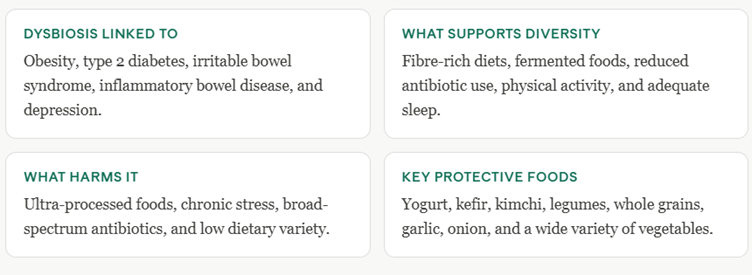
Many scientific articles prove that microbial imbalance, reduced production of short-chain fatty acids, and neuroinflammation are all associated with changes in psychological state characterized by anxiety and depression. Some strains of Lactobacillus and Bifidobacterium bacteria may affect the HPA-axis and suppress stress responses.
Over 250 scientific studies of the relation between microbiome balance and mental state have been conducted in 2023 only. Moreover, over 4.6 million products aimed at restoring psychological wellbeing by affecting microbiome composition were bought throughout North America and Europe in the same period. It is obvious that nowadays microbiome research goes way further than simple advice to eat more yogurt.
Gutand Immune System: The Defense Team Within
Between 70% and 80% of the body's immune cells reside within the gastro-intestinal tract, thereby making it one of the organs with considerable immune activity. A thriving microbial community constantly trains the immune system to distinguish between what needs tolerance and what must be defended from any foreign invader.
According to CDC, an estimated 60 million to 70 million individuals suffer from digestive diseases in the United States each year, and many studies have proven that imbalance of gut microbiota increases susceptibility to infection and inflammation. As a result, consumers are increasingly aware of dietary supplements for immunity such as probiotics, postbiotics, and fermented food products.
Opportunities and Challenges Within the Business Environment for Gut Health Supplements
The business environment in relation to gut health supplements has blossomed greatly in recent times. For example, probiotic supplements comprised nearly 49.9% of the global gut health supplements market size in 2024. Interestingly, probiotics constitute the most popular type of supplement owing to their capability to restore and maintain a balanced gut microbiome. Around 26% of the market is occupied by prebiotics whereas symbiotic (both probiotics and prebiotics) constitutes the most rapidly expanding sector, selling approximately 12.5 million units in 2023 versus 8.1 million in 2021.
In India, the growing health consciousness, increasing earnings among the middle class, and the prevalence of digital health information have boosted the demand for gut health
supplements.The South Asia region is anticipated to generate revenue worth roughly 31% ofthe global gut health supplement market during the forecast period. Some of the prominent FMCG and pharmaceutical companies that have launched gut health supplements include Nestlé Health Science, Bayer, and Pfizer.
Next-generation microbiome sequencing technology is set to revolutionize current probiotic useby transitioning away from general probiotics to specialized strain-based probiotics for targeted diseases like IBS, IBD, and metabolic conditions. In America, a survey revealed that 57.6% of adults used dietary supplements in the past thirty days.
Personalized Nutrition: The Next Big Thing?
Without a doubt, one of the most dramatic changes in modern-day nutrition is the shift away from generic diet recommendations to personalized diets. With the advent of next-gene sequencing, metabolomics, and wearables, mapping a person’s microbiome composition, spotting their metabolic bottlenecks, and predictingtheir food sensitivities is possible.
Tests for the consumer’s microbiome, artificial intelligence-driven diet plans, and personalized nutrition supplements are now the standard. Moreover, there is still a lot more that science can offer. According to the recent research shared at the Probiota 2025 Conference held in Copenhagen, the person’s microbiome can be the decisive factor in efficient digestion regulation.
Challenges: Misinformation, Regulatory Issues, and Dependence
There were a number of issues that followed the rapid development of the gut health sector. Firstly, there is no consistent scientific evidence concerning the efficacy of supplements. Not all supplements sold in the market prove their efficiency in terms of gut health improvement. Secondly, the quality and strains may differ greatly from supplement to supplement.
Differences in regulation still exist. While drugs go through the process of pre-market registration and certification, dietary supplements follow another regulation pattern. They are not subject to pre-market evaluation of their safety and efficacy. The US FDA proposed an increase in its authority in regulating dietary supplements in its FY2025 budget proposal.
Misinformation about the gut microbiota dominates social networks. Cures for leaky gut, detoxteas, and other popular remedies do not always rely on scientific evidence but attract people's attention and promote dietary supplements' sales. Exaggeration may lead consumers to be sceptical towards this whole area.
There is no replacement for natural food. Supplements are meant to complement one's diet rather than replace it. Plant-based and fibre-rich food is the best way to maintain a healthy microbiome.
Going Forward
At its best, the gut health movement represents a long-overdue change towards preventive and personalized medicine. At its worst, it represents an exploitative strategy to market scientifically complicated but scientifically uncertain products. Striking a balance between the two involves a dedication to evidence above all else.
One solution for individuals could start with recognizing the significance of diversity within their diet by ensuring they consume plenty of fruits, vegetables, legumes, grains, and probiotic foods. Regarding supplements, consulting with a healthcare provider and researching clinically tested strains along with quality certification from a third party becomes essential.
The gut is not a trend. It’s the foundation of something much bigger. Gut health shapes our immunity, our metabolism, even our mental wellbeing for life. With advances in research opening up possibilities for precision interventions, we can make better health a reality – if this science is approached with integrity and equity.
Reference
[1] https://www.grandviewresearch.com/industry-analysis/gut-health-supplements-market-report
[2] https://www.ncbi.nlm.nih.gov/pmc/articles/PMC10970241/
[3] https://www.ncbi.nlm.nih.gov/pmc/articles/PMC11394554/
[4] https://www.marketgrowthreports.com/market-reports/gut-microbiome-market-113434
[5] https://www.marketresearchfuture.com/reports/digestive-health-supplements-market-68360
[6] https://www.marketgrowthreports.com/market-reports/gut-microbiome-market-113434
[7] https://www.futuremarketinsights.com/reports/gut-health-supplement-market
[8] https://www.datamintelligence.com/research-report/gut-health-supplements-market
[9] https://www.ncbi.nlm.nih.gov/pmc/articles/PMC8770392/
[10] https://www.datamintelligence.com/research-report/gut-health-supplements-market
[11] https://www.custommarketinsights.com/report/gut-microbiome-market/