
Redefining the Anganwadis into Pre-Schools in NEP 2020: Minimizing the Policy Vision and Ground Realities
The Indian education landscape is in the process of a seismic shift as it is no longer centred on the primary and secondary school education but taking a more holistic and developmental approach. The practice of Early Childhood Care and Education (ECCE) during decades became a victim of bureaucratic silos due to the so-called iron curtain between the health services and educational pedagogy. But the National Education Policy (NEP) 2020 has turned this space around and acknowledged the fact that more than eighty five percent of cumulative brain construction happens before the age of six (Ministry of Education, 2020). The policy seeks to universalize high-quality pre-school education among children between the age of 3-6 by incorporating the Anganwadis into the formal 5+3+3+4 system of education. However, moving a nutrition-oriented centre to a so-called Learning Lab is not an easy process accompanied by structural, financial, and cultural challenges.
The Historical Context: A Link that is Missing in the Chain
In the past, the Ministry of Women and Child Development (MWCD) administered the Integrated Child Development Services (ICDS), with survival measures of immunizations, supplementary nutrition, and maternal health being the most important. On the other hand, it was only after a child attained the age of six that the Ministry of Education (MoE) was put in charge.
It was this fragmentation that resulted in an enormous readiness gap. Whereas the children of wealthy families pursued their studies in private play schools with advanced Montessori pedagogy, children who were enrolled by the Anganwadi system were frequently treated as welfare recipients and not as students.
NEP 2020 vision: Survival to Thriving
The NEP 2020 has triggered a convergence requirement. It involves MWCD and the MoE to overcome their historical silos and to transform the Anganwadis into centres of life with ECCE. The main goal is to combine nutrition and health services with the high-quality, research-supported, play-based learning opportunities.
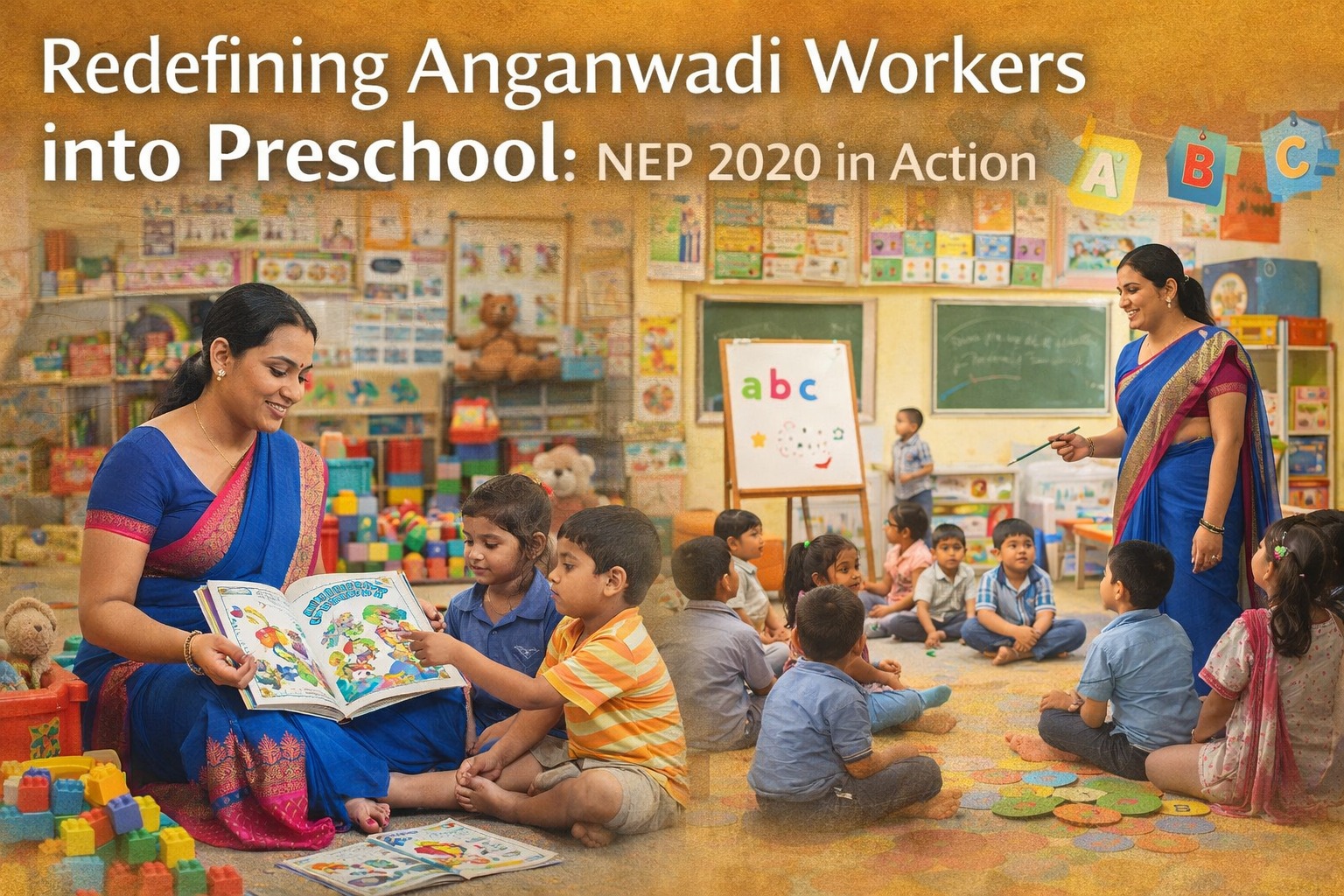
Their revolution is to re-vision the Anganwadi Worker (AWW) as an educator rather than simply as a caregiver and to be able to give a child a multi-level, flexible, play-based curriculum. This transition aims at making sure that all children irrespective of their socio-economic status are equipped to go to Grade 1 with cognitive and socio-emotional resources necessary to the formal school learning.
Present Situation: A Landscape in Transition
The process of transition is turning out to be one that is characterized by high friction. Although the policy offers an excellent roadmap, the last-mile implementation has the dilemma of an already strained workforce in terms of non-educational work loads, census data collection to election work. The situation on the floor is that it is a patchwork that the Anganwadi worker finds herself in between her old role as a health frontliner or new role as a pedagogical leader.
Issues: Upholding the Difficult Landscape of Reform
The way to change 1.3 million Anganwadis is blocked by a number of fundamental realities that tend to collide with the policy expectations:
1. Professional Identity Crisis,Training and Honorarium Crisis
This reform centres on the AWW (Anganwadi workers). They used to be trained to weigh infants and register inoculations. Asking such workforce to understand immediately the basic of Gyan Setu or the National Curriculum Framework (NCF) on the foundational stage is an overwhelming task. Moreover, at the same time, there exists a large Honorarium Gap. AWWs receive a low monthly salary that is too low compared to basic primary school teacher. The talent that is required in the position of a pre-school teacher cannot be readily attracted and retained without a clear career progression and improved financial incentives. Currently, the Anganwadi Workers (AWWs) and Anganwadi Help (AWHs) receive monthly honorarium as determined by Government periodically. Currently, honorarium of AWWs in main-AWCs is 4,500/ - per month; AWWs in mini-AWCs is 3,500/ - per month; AWHs is 2,250/ - per month. AWWs receive performance-based incentive of 500/- per month and in the case of AWHs performance-based incentive is 250/- per month. Very low in comparison with primary school teacher.
2. Deficiencies in Infrastructure and resources
The quality of education that an Anganwadi could give is frequently determined by the physical environment of this place. Some centres use small, rented rooms that are not even basicly sanitized, not to mention the so-called vibrant learning corners. BaLA (Building as a Learning Aid) designs are needed in the transition to an activity-based model such that walls, floors, and windows become an interactive tool. At this point, the unavailability of standardized learning resources (toys, picture books and manipulative kits) in the regional languages is still a chokepoint.
3. The Community Engagement and Perception Gap
In most of the rural areas, parents only see the Anganwadi as a khichdi centre. Reforming this attitude to identify the centre as a School is a huge communication campaign.The educational pieces of the picture are usually disregarded, and poor attendance becomes the result of hours spent in the activities of pre-literacy and pre-numeracy education.
4. The Bureaucratic Convergence Paradox
The most challenging administrative task is probably going through the complexities of convergence.There must be the coordination of two different ministries in terms of shared budgets, combined monitoring systems, and similar reporting systems. Accountability usually becomes diffused when goals are shared, but budgets are not.
Stakeholder Roles: Multi-Pronged Mitigating Strategy
In order to fill the gap between expectation and reality, all stakeholders have to cross over their conventional boarders:
The Government (National and State): Has to focus on the financial modernization of the role of AWW. This involves updating honorariums to reflect the professional expectations of the NEP. The government will also have to make sure that the convergence is not merely written on paper but also that it can be seen through joint task forces at the level of the district.
SCERTs (State Councils of Educational Research and Training): It is obliged to be the Nodal Academic Authority. Their task is to provide the process of contextualization of the indigenous toys, local dialects and folk narratives into the school curriculum to create an overcoming of the home language vs school language dichotomy.
Anganwadi Workers and Supervisors: These people should be in the spirit of continuous professional development (CPD). Instead of workshops that are done in a single occasion, they require cluster mentoring that involves hands-on pedagogic assistance by highly experienced primary teachers.
Parents and the Community: Needs to change their roles as passive receivers of welfare into active participants in the learning process of their child. A child can have regular ECCE Diwas (ECCE Days) where the milestones of the child should be demonstrated to the parents, thus creating confidence in the new system.
Way Forward: Development of the Foundation of the Foundation
To transform successfully Anganwadis into effective pre-schools, one has to change the mindset of compliance to the quality mindset:
Investment in Capacity: The training must be continuous and tutored. We require a set of teachers of ECCE who are trained to realize that play-based learning is not a scientifically supported method only for fun.
Infrastructure as Pedagogy: The upgrading of Anganwadi infrastructure needs to be addressed as a pedagogical investment. Children need to be in safe and vibrantand resource-rich environments in order to develop interests.
Data-Driven Monitoring: It is time to go beyond monitoring inputs (food distribution) to monitoring outcomes (cognitive and socio-emotional growth). Evidence-based policymaking can be supported by using digital tools in real-time tracking developmental milestones.
Enhancing convergence: Establishing special coordination departments at the block and the district levels will make the health, nutrition, and education operate in sync, and not in opposite direction.
References:
Ministry of Education. (2020). National Education Policy 2020. Government of India. https://www.education.gov.in/sites/upload_files/mhrd/files/NEP_Final_English_0.pdf
Ministry of Education. (2022). National Curriculum Framework for Foundational Stage. Government of India.
Ministry of Women and Child Development. (2023). Annual Report 2022-23. Government of India.
National Council of Educational Research and Training [NCERT]. (2022). Position Paper on Early Childhood Care and Education.
UNESCO. (2021). State of the Education Report for India: No Teacher, No Class. UNESCO New Delhi Cluster Office.
World Bank. (2022). The State of Global Learning Poverty: 2022 Update. World Bank Group.
Press Information Bureau. (2023, December 13). Honorarium of Anganwadi workers. Ministry of Women and Child Development, Government of India. https://pib.gov.in/