
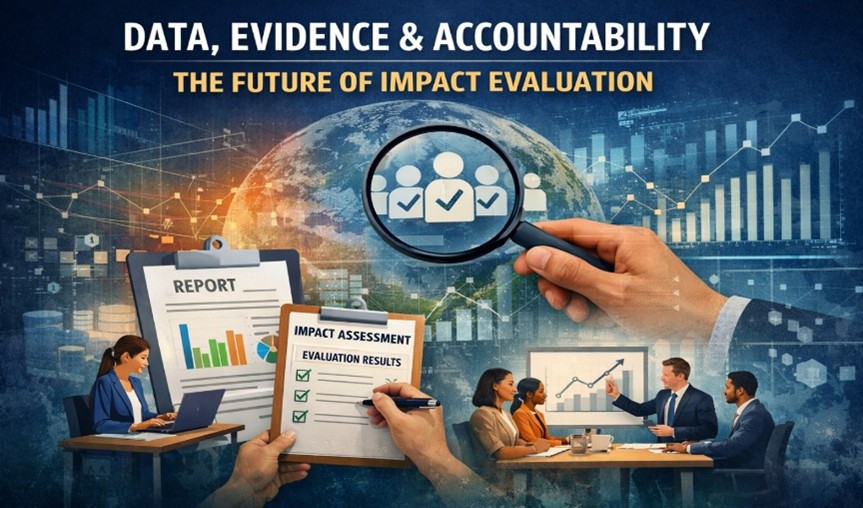
Data, Evidence, and Accountability: The Future of Impact Evaluation
The development programs are developed with an intention of bettering the lives of people. Welfare programs are initiated by governments. Community projects are practiced in non-profit organisations. The international agencies assist in education, health and livelihood programs. Such efforts cost the government billions of dollars every year. Nevertheless,there is always a question that is significant.
Are they programs that work?
Activities were used in quantifying the success of development programs over many years.The reports were centered on the number of individuals who were trained, the number of schools constructed, or the number of services provided. Such figures were practical yet they did not necessarily indicate whether the programs enhanced the lives of people or not.
Impact evaluation comes in at this point. Impact evaluation assists in establishing whether some change has been brought about by a policy or an intervention, which is real and measurable. It is result-oriented and not activity-oriented. Data, evidence, and accountability are now being used in the development practice as a central parameter of comprehending program effectiveness.
A combination of these factors is defining the future of impact assessment and empowering development policy decision-making.
Knowledge on Impact Evaluation
Impact evaluation is a process that is applied in determining the impacts of a program, policy or an intervention. It determines the extent to which a project has caused alterations in the well-being of people who can be directly attributed to the intervention.
Putting it simply, impact evaluation is a response to a valuable question:
So, what was the difference the program made?
To provide this, evaluators make comparisons between two situations. The former is what was experienced by individuals who joined the program. The second is what would have been observed had they not been involved. This latter case is referred to as the counter factual. Comparison of these two groups will help the evaluators establish whether the observed change was caused by the program. In the absence of this comparison, it will be somewhat hard to determine whether there were any improvements due to the intervention or due to other external factors.
An example of this is when a government initiates a training program to farmers. Farmers also report increased crop yield after the training. The program appears to be successful at first sight. The rise in yields could however be attributed to the fact that there was increased rainfall or better prices in the market. Impact evaluation assists in isolating the impact of the training program. Impact evaluation enables the policymakers to formulate superior programs as well as channel funds more efficiently by determining what really works.
Shifting the Focus off Outputs to Outcomes
Conventional development monitoring tends to concentrate on results. Outputs are the short-term consequences of program actions.
Examples of outputs include:
· Workshops held.
· Beneficiary figures achieved.
· Financial support given out.
· Number of health services provided.
Although these indicators are significant, they are not the best to measure the success of a program. Impact evaluation is the change in focus on the results of production.
Outcomes are what are realized by beneficiaries. These may include:
· Increased household income
· Better health and nutrition.
· Higher school attendance
· Improved working conditions.
· Greater accessibility to social services.
Measuring results can be used to know whether a program is indeed changing the lives of people.
As an example, a training program can state that hundreds of women attended the training. This is an output. However, the question is doing those women obtain jobs, establish enterprises or earn more after that.
The impact evaluation is useful in providing the answer to this question by looking at the longer-term outcomes of development intervention.
The purpose of Data in Impact Evaluation
Effective evaluation is based on data. It cannot be able to measure program outcomes without having reliable data.
Some of the advancements in technology, especially related to development programs, have occurred in the past few years and have changed the means of data collection and analysis. The development organisations are dependent on various sources of data.
These include:
· Household surveys
· Administrative records
· Digital monitoring systems
· Mobile data collection tools are utilized inthe study.
· Satellite and geospatial information.
Monitoring systems collect information concerning program inputs, program activities, program outputs, and program outcomes. This stream of information allows monitoring the progress in programs and detecting the issues at the initial stage.
Monitoring is a description of the continuous and systematic gathering of information in order to evaluate the progress towards the program objectives.
Nevertheless, statistics are insufficient. The information that comes in large quantities can be misleading when handled in the wrong manner.
It requires the strong analytical methods to interpret the data. Impact evaluation is the method of evaluation that involves the application of statistical procedures and research designs to evaluate whether changes will be actually attributed to the program.
This makes the development programs tested after valid evidence as opposed to guesses.
Technology and the Falling Landscape of Evaluation
The evaluation profession is being changed by technological innovation.
Organizations are now able to gather data very fast, and in a very efficient way through the use of digital tools. Information can be collected through mobile based surveys, especially in remote societies. With the help of cloud-based databases, one may store and analyze large datasets. The evaluation process is also being enhanced with the help of new analytical tools datasets.
The evaluation process is also being enhanced with the help of new analytical tools.
For example:
· Big data analytics is able to detect trendsamong numerous data.
· Machine learning tools are able to examinemulti-dimensional relationships among variables.
· Geospatial technology has the ability to trackenvironmental and infrastructure changes.
The technologies enable the development organizations to measure program outcomes with more precision and at a larger scale.
The other change of significance is the transition to real-time monitoring. The assessment was traditionally done when a program was over. In the present times, organizations are rampantly employing real time data in order to make program modifications during implementation. This enables development efforts to be more adaptable and receptive to the evolving conditions.
Evidence based decision making.
Impact evaluation is an important part in evidence-based policymaking. Evidence-based policymaking describes the application of valid research work and trustworthy data in making policy decisions. Policymakers do not depend solely on political priorities or assumptions and base their programs on empirical evidence.
This has become a very important approach in public policy. Development organizations and the governments are increasingly finding themselves under pressure to show that the money being spent by the people is being utilized effectively. Evaluation systems might enable policy makers to know which programs are effective, which are not and why.
Once the evidence is found that a program has been successful, it can be modified to serve more beneficiaries or be replicated elsewhere. Conversely, those programs whose objectives are not met can be re-modelled or scrapped.
Evidence-based development practices have been greatly advocated by international organizations (World Bank) and OECD. These organizations underline that effective policy decisions and better development outcomes require a sound evidence base on which to base their decisions. Impact evaluation also contributes to collective learning in the development sector. By documenting both successes and failures, evaluations create a knowledge base that helps improve future programs.
Evidence-based development practices have been greatly advocated by international organizations (World Bank) and OECD. These organizations underline that effective policy decisions and better development outcomes require a sound evidence base on which to base their decisions. Impact evaluation also contributes to collective learning in the development sector. By documenting both successes and failures, evaluations create a knowledge base that helps improve future programs.
Accountability and Transparency
Impact evaluation also helps in group learning in the development sector. Evaluations make a knowledge base that is used to improve future programs by recording the successful experiences and failure. The focus of impact evaluation is not merely regarding improvement of programs. It enhances accountability as well.
Most of the development programs are based on the funds or the donations of the people. This poses a duty of ensuring effective utilization of resources.
Evaluation gives clear testimony of the performance of programs. It assists the stakeholders of knowing whether development initiatives are attaining the objectives.
Monitoring and evaluation systems enable the governments, donors, and citizens to determine the success of the social programs. Effective assessment systems are capable of facilitating sound debates and decision making in governmental institutions.
Openness also installs trust between the citizens and governments. By the openness int he release of evaluation findings, this will invite a broader discussion and questioning.
Evaluation findings in most instances enable communities to lobby to make services and policies better. Through this, accountability is a significant impact evaluation outcome.
Problems with Impact Evaluation
Impact evaluation suffers a number of challenges even though its importance is paramount. Data quality and availability is one of the challenges. In most areas, there might be poor administrative data or information. This complicates measurement of results. Complexity of methods of evaluation is another challenge. Strict impact analyses can involve sophisticated research designs and statistics knowledge.
Typical evaluation strategies are:
· Randomized Controlled Trials (RCTs).
· Quasi-experimental methods
· Longitudinal surveys
Such techniques are costly and time-consuming.
The ethical considerations are relevant too. The researchers should be careful to make sure that the evaluation designs neither injure the vulnerable audiences nor prevent them to access the necessary services.
Lastly, policy change does not always follow strong evidence even in the presence ofthe evidence. Evaluation findings may not affect decision-making due to political priorities, institutional constraints and limited resources. The solution of these problems is to have better assessment and more involvement of research in the policymaking procedures.
The Future of Impact Evaluation.
A number of key trends will define the future of impact evaluation. To begin with, digital technologies will see an improvement in data collection and analysis. It will be easier to monitor program outcomes through real-time monitoring systems.
Second, participatory evaluation will become more popular. The communities will be increasingly involved in evaluating the programs which impact their life. Third, the open data initiatives will enhance transparency. The findings of evaluation will be more available to the researchers, policymakers, and citizens. The other important change is incorporating evaluation in the program design. Organizations are currently incorporating evaluation structures into the planning process, as opposed to assessing the projects after the completion. This enables the programs to evolve and become better in the implementation process. Finally, impact evaluation aims not at measuring results but also at improving them.
Conclusion
Impact evaluation has also become a standard part of the contemporary development practice. The world is full of scarcity of resources and social issues that should be tackled with the need to know what works and what does not. Data gives the information required in measuring change. It is that information thatis converted into insights through evidences. Through accountability, these insights are applied responsibly. All these three factors combined constitutethe basis of good development policy. Through effective assessment mechanisms and adopting evidence-based decision making, governments and development agencies can develop superior programs, distribute resources effectively, and eventually enhance outcomes of people they are serving. The developmental future will not rely only on the good intentions, but also on evidence of actual change being observed.
Reference
- https://www.worldbank.org/en/topic/communitydrivendevelopment/brief/cdd-monitoring-evaluation
- https://www.oecd.org/en/topics/sub-issues/public-policy-monitoring-and-evaluation.html
- https://www.oecd.org/en/publications/building-capacity-for-evidence-informed-policy-making_86331250-en.html
- https://onlinecourses.bsg.ox.ac.uk/blog/guide-to-evidence-based-policymaking
- https://www.worldbank.org/en/topic/education/brief/building-evidence-in-education
- https://whatworksgrowth.org/resource-library/understanding-impact-evaluation/